Showing posts with label books. Show all posts
0

Review: Perfectly Possible

Published on Sunday, July 09, 2017 in , , , , , , ,

Michael Daniels' Perfectly Possible e-bookMany regular Grey Matters readers will be familiar with Michael Daniels' Mind Magician site, where he teaches numerous math and memory feats, such as calculating cube roots in your head instantly. He's recently written a new ebook on the 4-by-4 magic square, titled Perfectly Possible. I found it to be well worth the time and money invested, and wanted to share my thoughts with Grey Matters readers.

This is going to be a difficult review, as I can't give too much away, but I also want to share with you the quality of this method. I'll start with the qualities promoted by Michael Daniels himself:

  • Completely impromptu. No set-up, gimmicks, or cribs.
  • New, improved method - minimal memory and the simplest of calculations.
  • Suitable for close-up or stage performances.
  • Produces elegant magic squares.
  • Can be immediately repeated for different totals.
  • Includes a browser application that helps you to learn and practice (Internet connection not required).
Let's clarify a few points here. Yes, it is completely impromptu. This is a calculation method, but the calculations are minimal, quick, and will quickly become second nature during practice. Speaking of practice, the included browser application is very handy. It's similar to the magic square practice app posted at mindmagician.org, but streamlined for the new routine.

What does "elegant magic squares" mean? One problem with many magic square approaches is that the number can appear unbalanced, such as when 12 of the numbers are less than 15, and the other 4 are over 30. This can give your audience clues about the method. With the Perfectly Possible method, you don't have to worry about that. You're guaranteed a balanced magic square. Elegant also means that you're guaranteed at least 36 different ways in which some combination of 4 squares gives the magic total. Under the right circumstances, this method can yield as many as 52 different combinations!

As with any magic square, the ability to repeat the square immediately with different totals is, of course, essential. Even more impressive, though, is that if 2 people give you the same total, you can still generate a different magic square! Naturally, the same total requires the numbers used to be in the same general range, but this method will allow you to put different numbers in each of the squares with very little difficulty.

That quality is really what makes Perfectly Possible stand out. Unlike the rigid approaches behind most magic squares, the ability to take multiple approaches gives the performer more freedom while disguising the method very effectively. When a change is as constrained as the magic square, finding an approach like this that offers you remarkable degrees of freedom like this is incredible!

If you're interested in creating magic squares, I can't recommend Michael Daniels' Perfectly Possible ebook enough. It's available for $6 on its own, or $8 in combination with Mostly Perfect, its predecessor. If you're seriously consider this as a performance piece, I would also recommend the Unknown Mentalist's Why A Magic Square Should Not Be A Magic Square ebook. It teaches many very effective original presentations that disguise the principle, and will help preserve the mystery by showing you how to prevent audiences from simply searching for "magic square" on the internet during or after your performance.

3

Grey Matters' 10th Blogiversary!

Published on Saturday, March 14, 2015 in , , , , , , , , , , , , ,

Mehran Moghtadaei's Pi Digit GraphicEver since I started this blog, I've been waiting for this day. I started Grey Matters on 3/14/05, specifically with the goal of having its 10th blogiversary on the ultimate Pi Day: 3/14/15!

Yes, it's also Einstein's birthday, but since it's a special blogiversary for me, this post will be all about my favorite posts from over the past 10 years. Quick side note: This also happens to be my 1,000th published post on the Grey Matters blog!

Keep in mind that the web is always changing, so if you go back and find a link that no longer works, you might be able to find it by either searching for a new place, or at least copying the link and finding whether it's archived over at The Wayback Machine.

2005

My most read posts in 2005 were 25 Years of Rubik's Cube (at #2), and Free Software for Memory Training (at #1). It was here I started to get an idea of what people would want from a blog about memory feats.

2006

In the first full January to December year of Grey Matters, reviews seemed to be the big thing. My reviews of Mathematical Wizardry, Secrets of Mental Math, and Mind Performance Hacks all grabbed the top spots.

2007

This year, I began connecting my posts with the interest of the reader, and it worked well. My series of “Visualizing” posts, Visualizing Pi, Visualizing Math, and Visualizing Scale were the biggest collectively-read posts of the year.

Fun and free mental improvement posts also proved popular in 2007. Unusual Lists to Memorize, my introduction to The Prisoner's Dilemma, and my look at Calculators: Past, Present, and Future (consider Wolfram|Alpha was still 2 years away) were well received! 10 Online Memory Tools...For Free! back-to-back with my Memorizing Poetry post also caught plenty of attention.

2008

I gave an extra nod to Pi this year, on the day when Grey Matters turned Pi years old on May 5th. The most popular feature of the year was my regularly update list of How Many Xs Can You Name in Y Minutes? quizzes, which I had to stop updating.

Lists did seem to be the big thing that year, with free flashcard programs, memorizing the elements, and tools for memorizing playing card decks grabbed much of the attention in 2008.

2009

Techniques took precedence over lists this year, although my series on memorizing the amendments of the US Constitution (Part I, Part II, Part III) was still popular. My web app for memorizing poetry, Verbatim, first appeared (it's since been updated). Among other techniques that caught many eyes were memorizing basic blackjack strategy, the Gilbreath Principle, and Mental Division with Decimal Precision.

2010

This year opened with the sad news of the passing of Kim Peek, the original inspiration for the movie Rain Main. On a more positive note, my posts about the game Nim, which developed into a longer running series than even I expected, started its run.

As a matter of fact, magic tricks, such as Bob Hummer's 3-Object Divination, and puzzles, such as the 15 Puzzle and Instant Insanity, were the hot posts this year.

Besides Kim Peek, 2010 also saw the passing of Martin Gardner and Benoît Mandelbrot, both giants in mathematics.

2011

The current design you see didn't make its first appearance until 2011. Not only was the blog itself redesigned, the current structure, with Mental Gym, the Presentation section, the Videos section, and the Grey Matters Store, was added. This seemed to be a smart move, as Grey Matters begin to attract more people than ever before.

The new additions to each section that year drew plenty of attention, but the blog has its own moments, as well. My list of 7 Online Puzzle Sites, my update to the Verbatim web app, and the Wolfram|Alpha Trick and Wolfram|Alpha Factorial Trick proved most popular in 2011.

My own personal favorite series of posts in 2011, however, was the Iteration, Feedback, and Change series of posts: Artificial Life, Real Life, Prisoner's Dilemma, Fractals, and Chaos Theory. These posts really gave me the chance to think about an analyze some of the disparate concepts I'd learned over the years when dealing with various math concepts.

2012

In 2012, I developed somewhat of a fascination with Wolfram|Alpha, as its features and strength really began to develop. I kicked the year off with a devilish 15-style calendar puzzle, which requires knowing both how to solve the 15 puzzle and how to work out the day of the week for any date in your head! Yeah, I'm mean like that. I did, however, release Day One, my own original approach to simplifying the day of the week for any date feat.

Estimating Square Roots, along with the associated tips and tricks was the big feat that year. The bizarre combination of controversy over a claim in a Scam School episode about a 2-card bet and my approach to hiding short messages in an equation and Robert Neale's genius were also widely read.

2013

After we lost Neil Armstrong in 2012, I was inspired to add the new Moon Phase For Any Date tutorial to the Mental Gym. A completely different type of nostalgia, though, drove me to post about how to program mazes. Admittedly, this was a weird way to kick off 2013.

Posts about the Last Digit Trick, John Conway's Rational Tangles, and Mel Stover were the first half of 2013's biggest hits on Grey Matters.

I also took the unusual approach of teaching Grey Matters readers certain math shortcuts without initially revealing WHY I was teaching these shortcuts. First, I taught a weird way of multiplying by 63, then a weird way of multiplying by 72, finally revealing the mystery skill in the 3rd part of the series.

2014

Memory posts were still around, but mental math posts began taking over in 2014. A card trick classically known as Mutus Nomen Dedit Cocis proved to have several fans. The math posts on exponents, the nature of the Mandelbrot set, and the Soma cube were the stars of 2014. Together, the posts Calculate Powers of e In Your Head! and Calculate Powers of π In Your Head! also grabbed plenty of attention.

Wrap-up

With 999 posts before this one, this barely even scratches the surface of what's available at this blog, so if you'd made it this far, I encourage you to explore on your own. If you find some of your own favorites, I'd love to hear what you enjoyed at this blog over the years in the comments below!

1

Review: The Best Mental Math Tricks

Published on Sunday, February 22, 2015 in , , , , ,

Presh Talwalkar's book The Best Mental Math TricksTwo years ago, about this time, I reviewed Presh Talwalkar's previous Infinite Tower book.

Since then, not only has Presh not only been hard at work on his Mind Your Decisions blog, but also another book guaranteed to interest Grey Matters readers! This newest book is titled The Best Mental Math Tricks. Presh was kind enough to send me an advance copy, so I'll share my review in this post.

Probably the first thing to stand out about this book, when reading the table of contents, is that it's organized almost exactly backwards to most arithmetic, and even most mental math books. It starts out with a variety of mental math shortcuts for specific situations, then moves on to squaring shortcuts, followed by multiplication shortcuts, then division shortcuts, and it closes with another variety of shortcuts.

There's nothing bad about this approach. As a matter of fact, since the subject is mental math, this actually allows the shortcuts to be described in a rough order of simpler to more complex. It's also a nice change from the standard order of adding/subtracting to multiplication/division to roots/powers.

When you learn this book is put out by the author of a blog, you might be concerned that this is just a collection of previous mental math blog posts that you could access online for free. While there is some overlap, there's plenty of material in the book that has never been posted on the author's blog. Conversely, there are also several mental math shortcuts on his blog which don't appear in the book, so Presh's book and site wind up complementing each other quite nicely.

Even when there is crossover, the entry isn't simply copied straight from the blog to the book. For example, Presh wrote a post titled Understanding the rule of 72: a popular rule that has little practical value that was highly critical of this standard shortcut. In the book, however, the rule of 72 is taught with a less critical review, while still giving the reader an understanding of when the rule is and isn't appropriate to use.

The structure of each shortcut is also well thought-out. Each one starts with a description of the shortcut itself, followed immediately by practice problems which help you internalize it. Just before providing the answers to the practice problems, however, Presh explains the proof behind each shortcut, so you can get a better understanding of why it works. This is probably one of the most useful and important aspects of the book. It's one thing to learn a rule, but another thing to understand the reasoning behind it.

If you're already familiar with mental math shortcuts, you're still likely to find enough new shortcuts to make this book worthwhile. If you're new to mental math, this book is a definite treat for the mind!

At this writing, The Best Mental Math Tricks isn't available yet, but Presh Talwalkar assures me that it will be released in the near future. When it is released, The Best Mental Math Tricks is now available at Amazon.com. I recommend to anyone interested in improving their mental math skills!

0

Math Shortcuts From Popular Science

Published on Sunday, June 22, 2014 in , , ,

Signe Karin's newsstand photoBack in the 1960s, Popular Science frequently included inserts focusing on topics of interest to their readers.

Since this was a science magazine in the days before pocket calculators were common, there were many times that the inserts focused on making mental calculations easier. Thanks to Google books, these are available once again!

Our first jump takes us all the way back to the January 1961 issue, which features excerpts from Lester Meyer's book, High Speed Math. The great body of the 14-page book digest focuses on shortcuts for multiplication, but towards the end, there are tips about addition, subtraction, division, and knowing when to use given shortcuts:


Later that same year, in November, they returned to this idea with an insert called “Math and Memory Short Cuts”. This particular book, for some unknown reason, was scanned in reverse page order. Despite that minor flaw, the insert is still readable. Instead of straight math shortcuts, this insert focused on math and memory techniques that were handy in the home workshop.


Popular Science returned to pure math shortcuts in December 1964, with their book digest of Isaac Asimov's Quick and Easy Math. This 7-page feature was arranged in the more traditional order of tips for addition, subtraction, multiplication, and division. If you're only familiar with Asimov's fiction writing, you might be surprised at the clarity he can bring to instructional writing:


Our final insert comes from the March 1967 issue, in an insert titled “High-Speed Math Short Cuts” This one is dedicated almost entirely to quick multiplication and division techniques, including a handy reference table giving the results of 1000 ÷ n for every integer n from 1 to 999, plus tips on using the table to handle larger numbers!


Obviously, these techniques were far more essential in the days before pocket calculators were common. However, the techniques are still useful, so they're fun to explore. You never know when and where you'll find that perfect shortcut for frequently-encountered problems!

0

Free Math Magic Books!

Published on Sunday, May 18, 2014 in , , , , , ,

Stewart Butterfield's bookshelf photoLast week, I gave you some free magazines to peruse.

This week, I have some books I'd like to share with you, and they're filled with a great selection of classic mathematical feats and magic!

The first book I'll share with you is a 1952 book titled Mental Prodigies, by Fred Barlow (embedded below). The first section is concerned purely with arithmetical prodigies, or what we might call lightning calculators or human calculators today. The next section discusses related types of prodigies, such as chess or music. Next, is a section on memory, including chapters on famous memorizers, as well as mnemonics and memory techniques for actors.

The chapter I think will be the most interesting to Grey Matters readers is the section on Mental Magic, starting on page 183. It includes many of the standard feats covered here on Grey Matters, such as day for any date, squaring, cubing, and finding roots.

However, there are some more unusual ones, such as calculating the number of farthings in a given number of guineas, or how many barleycorns there are in a given number of yards. Granted, these might not play too well today, but the same technique, as the author explains, can also be used to give the number of minutes in a given number of weeks!

After the embedded book below, scroll down further for another math magic book.


If you'd prefer more than just a few small chapters about mathematical magic, check out the 1950 classic, Math Miracles, by Wallace Lee.

Among the more unusual tricks here are the Ne Plus Ultra Lightning Multiplier and its variations. The Miscellanies chapter is filled with numerous quick and unusual tricks, including the 100 version of our old friend Nim!

I don't want to rob you of the joy of discovery however. Take a chance to page through these e-books, and you may find some unexpected treasures!

0

Free Math Magazines!

Published on Sunday, May 11, 2014 in , , , , , , , ,

Signe Karin’s newsstand photoMany of you are spending today with your mother in honor of Mother's Day, so I won't strain your brain too much today.

In fact, I'll just leave a few free magazines on the table for your perusal when you have some time later.

I'll start with the brand new Recreational Mathematics Magazine. This magazine is available as a whole PDF, or as PDFs of individual articles. The first article that caught my attention here was “The Secrets of Notakto: Winning at X-only Tic-Tac-Toe”. It caught my attention because I'd written about Notakto strategy 2 years ago, including how to win playing on 1 or 2 boards, and then how to win when playing on 3 or more boards.

Don't let me rob you of the joy of discovery, however. The other articles, including the one about Lewis Carroll's mathematical side, the one about vanishing area puzzles, and others are all waiting to be discovered.

The next math magazine I'd like to draw your attention to is Eureka, published by the Archimedeans, the Mathematical Society of the University of Cambridge, since 1939. New issues are being made available online for free by mathigon.org. This is no minor mathematical publication, either. It was the Archimedeans' Eureka magazine that, back in October 1973, had the honor of being the first to publish John Conway's Doomsday Algorithm for calculating the day of the week for any date.

Generally, The College Mathematics Journal isn't available online for free, but they have generously posted the full contents of their January 2012 Martin Gardner issue online for free! It's full of the kind of recreational mathematics which Martin Gardner loved and Grey Matters readers are sure to appreciate and enjoy. There are too many articles to single any one out for special attention, so I suggest jumping in and seeing what catches your eye first!

The final magazine I'll set out for your perusal isn't a mathematical magazine, but rather a magic magazine called Vanish, which is free to download, or read online as a page-flipping e-magazine. The reason I'm including it here with math magazines is because of Diamond Jim Tyler's article on “The Game of 31”. This is variation of our old friend Nim. For a Nim variation, 31 has a surprising amount of its own variations, including a dice version, a finger dart version, and a version which you can still scam someone after teaching them the secret!

That's all for now, so I'll wish you happy reading!

3

Danica McKellar's Math Bites

Published on Sunday, February 02, 2014 in , , , , , , , , ,

Danica McKellar's Math Bites seriesNo, I'm not insulting Danica McKellar's math ability, I swear! I even sell her math books over in the Grey Matters Store!

Math Bites is actually the name of Danica McKellar's new weekly video series from Nerdist, which started last month.

Math Bites can be found on YouTube, and you can subscribe to the Nerdist channel for regular updates, as well.

Each episode is only about 5-6 minutes long, and focuses on one math topic. The style is somewhat like that of Square One TV, in that there are short comedy skits and musical segments that help reinforce the concepts or give you breathing time to let the concepts sink in. I especially like the takeaway tips at the end of each episode, which summarize the important points of each episode.

The first episode focused on a topic near and dear to my heart, the constant Pi:


While many Grey Matters readers have memorized Pi to 400 digits, some might prefer the full Dance of the Sugar Pi Fairy to help them memorize Pi to 139 digits.

The second episode talked about the importance of being able to do math in your head. No, this episode doesn't talk about extraordinary mental math feats like those taught in the Mental Gym, but rather knowing how to do basic arithmetic and estimation well enough so that you don't get ripped off:


You can already get an idea of why I like this series so much. It touches on the basics of topics I've posted about many times before. I've posted about binary numbers both on their own, and their importance in Nim, so the 3rd episode on binary numbers was also helpful and entertaining:


The most recent episode as of this posting is about percentages, and focuses on how they can mislead you. Sometimes you can get taken advantage of when businesses can't do math, and also when businesses can do math, so percentages can be very important to understand:


Even if you missed the initial announcement of Math Bites, you're now completely caught up with the series. Here's hoping that Danica McKellar keeps this series up for a long time to come!

0

Yet Still More Quick Snippets

Published on Thursday, January 23, 2014 in , , , , , , , , , , ,

Luc Viatour's plasma lamp pictureFor January's snippets, I'm featuring an unusual mix.

This time around, I've got 3 different things for you: Math, memory...and Macs?!?

• Numberphile took a breather from their usual number videos to do something a bit different. They interviewed UC Berkeley professor Edward Frenkel with the question, “Why do people hate mathematics?” It's an interesting topic and well worth your time:


• In the video above, they talk about the important roles of math teachers. Longtime Grey Matters readers know that I'm not just a big proponent of memorizing, but rather memorizing along with understanding. Above and beyond great sites that aid in mathematical understanding, such as BetterExplained and Plus magazine, there's also an excellent free ebook called Nix The Trix. It's aimed at students who are great with shortcuts, but never took the time to understand the foundations of what those tricks are actually doing. It can help teachers undo the damage by showing how to teach the actual mathematical basis, which is also a great help in understanding when to use the math tricks.

• Almost just in time for this month's snippets, Reddit featured an interesting and popular thread asking, “What are some things worth memorizing?” Yes, of course, there are the usual array of sarcastic and silly answers, but if you take the time to wade through some of the roughly 12,000 comments (at this writing), there are some great ideas. I won't rob you of the joy of discovery, especially as the reply you most enjoy may not even exist yet as I write this!

• If you've ever memorized something with the help of spaced learning, where the concept you're trying to memorize is reinforced 3 times at spaced intervals, you know how powerful it can be. There's now an online web service called MemStash which help you do this almost automatically. You save things you wish to remember by highlighting them in an online page, and then clicking a special MemStash bookmarklet. After that, they'll send you 3 reminders at spaced intervals, which can help you recall what you saved!

• OK, this last snippet isn't really along the usual Grey Matters topics, but I thought it would be fun to sneak it in. 30 years ago this week, the Apple Macintosh computer first came on the market. During Super Bowl XVIII on January 22, 1984, they aired their now-classic 1984 ad, announcing the upcoming release of the Macintosh on January 24th. The lesser-known January 24, 1984 introduction of the Macintosh has also been preserved on video:


That's all for this month's snippets. I hope you enjoy them!

0

Still More Quick Snippets

Published on Sunday, December 15, 2013 in , , , , , , , , , , ,

Luc Viatour's plasma lamp pictureIt's time for December's snippets.

I've noticed the simpler, more direct skills prove popular, so this month will feature more skills you can learn, use, and demonstrate quickly.

• We'll start off with a simple skill: figuring out your longitude by looking at the night sky, assuming you're in the northern hemisphere. First, you need to find the star Polaris, which is why you need to be in the northern hemisphere for this to work. If you don't know how to do that, my post from September about learning to find various stars will be of help here.

The next step is to determine how many degrees above the horizon Polaris is located. This post from One Minute Astronomer shows how to measure the approximate angle using only your hands! This is a fun skill to demonstrate and teach, as well.

• From arrangements of stars, we come down to earth to arrangements of numbers. Michael Daniels, over at mindmagician.org, has posted a new magic square generator which can handle any integer from 34 through 9999. If you're curious about the method used to create these, you can learn more about it in his ebook, Mostly Perfect. You can even download free excerpts from the book for free!

• One of my favorite feats, the calendar feat, is taught in a very simple and direct version in the following video from Mister Numbers:


If you're not already familiar with Mister Numbers' work on YouTube, check out his channel, and see some of his other work in number patterns. He details more about this calendar procedure in his Kindle ebook, Amazing Calendar Math Magic.

This method has it roots in John Conway's Doomsday Method, and I show how to build on this basis in a simple way to handle almost any year in my ebook, Day One.

• Also from Mister Numbers, here's an impressive video that quickly teaches kids, or anyone really, to be able to handle multiplying the numbers from 1 to 40, and beyond, by themselves in a simple way:


I take advantage of this same basic pattern in my lessons on extracting the roots of perfect squares over in the Mental Gym, so this is a very useful pattern to know!

I hope you've found something quick an interesting. Have any quick and interesting math tips or patterns of your own? I'd love to hear about them in the comments!

0

It's All About The Benjamin

Published on Sunday, November 10, 2013 in , , , , , , , , , , ,

Procsilas Moscas' number grid pictureEven if you're not into mathematical magic and mental math, you're probably familiar with Dr. Arthur Benjamin from one or more of his TED talks.

Another video of his mathemagical feats has surfaced on the web, but this one includes the methods of each routine!

This video lecture is titled The Magic and Math of Mental Calculation, and was held at the 2013 Martin Gardner Celebration of Mind in Washington DC, courtesy of the Mathematical Association of America and Math For America-DC.

The Magic and Math of Mental Calculation is done in full lecture style, and runs about 78 minutes. It is introduced by MAA's Ivars Peterson and Thinkfun (Amazon.com link) CEO Bill Ritchie:


Granted, the single unmoving camera angle could make things hard to follow, but I've gathered numerous links which I hope will make everything clearer.

First, Ivars Peterson mentions that April is Mathematics Awareness Month, with the 2014 theme being Mathematics, Magic and Mystery, after the Martin Gardner book of the same name (Amazon.com link).

Dr. Benjamin starts out by squaring 2-digit numbers in his head. This feat is relatively easy to learn, and the Mental Gym even features a 2-digit squaring tutorial and quiz. The later explanation features some excellent advice on working up to squaring 3- and 4-digit numbers.

This is followed by the missing digit feat, which is explained much later in the video, so I'll come back to it.

Next up is a magic square feat. The explanation can be tricky to follow. Fortunately, Dr. Benjamin has posted the instructions for his Double Birthday Magic Square online for free. There are several essential tips in the video that make the performance of this far better than if you'd just learned from the PDF alone.

When he talks about how he developed the magic square routine in the first place, he mentions a 2003 magic square article in a magic magazine. This seems to be Harry Lorayne's article, 4×4 Magic Square Breakthrough??. The original magazine article isn't easy to find, but the entire article was reprinted in Harry Lorayne's book, Mathematical Wizardry (Amazon.com link), which I reviewed here back in 2006.

The calendar feat, as many Grey Matters readers already know, is a favorite of mine. You can follow along Dr. Benjamin's somewhat brief explanation of the feat with the help of the Day of the Week For Any Date tutorial and quiz here. I have done my own work simplifying the calendar feat in my Day One ebook.

Impressively, Dr. Benjamin even fields a question about mentally determining whether a 3-, 4-, or 5-digit number is prime or not, despite not performing any feats related to this. If you're wondering why he's using this particular approach, my prime number testing post from earlier this year may make things clearer.

Coming back to the discussion of the missing digit feat, it's hard to make this much clearer than it is on the video. There is the amusing question of whether zero is an even number, which Numberphile tackled in one of their videos.

Dr. Benjamin also discusses here what to do when you're not sure whether the missing digit is a 0 or a 9. My preferred approach here would be to say, “I'm not getting anything. It wasn't a zero, was it?” Note that by making this a negative question, you can follow up their answer with “I thought so” or “I didn't think so”, which makes you sound like you knew all along, even though you're just asking a question.

The lecture is wrapped up with the mental multiplication of 2 five-digit numbers. This isn't done as quickly as the other squaring feats. Instead, this is done with lots of verbal calculation and what seems to be some nonsensical words thrown in. First, as he explains after getting the number 37,947 to square, he points out that he's going multiply 37,000 by 947, double that number, square 37,000, square 947, and add all those results together.

Why is he doubling that first calculation? Effectively, he's breaking the problem down into (37,000 + 947)(37,000 + 947). As with any problem of the form (a + b)(a + b), Wolfram Alpha shows that the result must be a2 + 2ab + b2.

The mysterious words he's uttering are actually ways of remembering numbers. Arthur Benjamin has another free lecture available online that details how to memorize numbers like this.

As with many live lectures, this one winds up with several mentions, including that of Harvey Mudd College, where Dr. Benjamin teaches.

Several of Dr. Benjamin's books and DVDs are promoted in the lecture. Since Grey Matters is an Amazon.com affiliate, you can help support this blog by buying Dr. Benjamin's books through our affiliate link, his Secrets of Mental Math DVD (from which the above free number memorization lecture is taken), his Joy of Mathematics DVD, and/or any of the Amazon.com links listed above.

0

Numerous Wonders

Published on Monday, November 04, 2013 in , , , , , , , , ,

Shreyas Patil's photo of playing cardsIt's time for some magic!

Don't worry, there's no complicated sleight-of-hand in these tricks. Not only does math make them easy, but you don't even have to do any math during the routines, since all the math involved has been worked out ahead of time.

I'll start with the simpler of the tricks. In this first one, you have someone think of any hour of the day, and you tap numbers on an analog watch while they silently count up to 20. When they reach 20, they say “Stop!”, and your finger is on the hour they secretly chose!

The method behind this simple trick is described in Futility Closet's On Time post.

At first, the workings may confuse you, but a little experimentation with different numbers will help you understand it. Obviously, this is also true for anyone for whom you perform it, so don't treat this as a big mystery, but rather as a simple and interesting experience.

The basic tapping presentation has a long history in magic. In Martin Gardner's book, Mathematics, Magic and Mystery, there's an entire section on tapping tricks. Thank to Google Books, you can read the entire section online for free, running from page 101 to page 107.

The next trick, courtesy of Card Colm, is a little more involved. You have someone name any card suit, have a regular deck of cards shuffled, and then the number cards (Ace through 9) are removed in the order in which they're found in the deck. You then make an unusual bet based on divisibility of various numbers formed by those cards.

This trick is called the $36 Gamble, and the method is found in Card Colm's post, The Sequence I Desire. Magic: When Divided, No Remainder. Beyond just the mathematical method, there's plenty to explore under the hood of this routine, including Arthur Benjamin's method for determining divisibility by 7, and a very deceptive shuffling method, which appears fair.

If you enjoy the deceptive shuffles discussed in the above post and its links, you also might enjoy Lew Brooks' book Stack Attack, which features the False False Shuffle. The false shuffle and the routines in Stack Attack mix well with the principles behind the $36 Gamble. In my 2006 review of the DVD of the same name by the same author, you can get a better idea of the contents.

Even though I've only linked to 2 tricks here, practicing them, understanding them, and digging in to the variations I've mentioned is more than enough to get your mental gears turning, so have fun exploring them!

0

142857 And So On...

Published on Monday, October 28, 2013 in , , , , , ,

Melchoir's, AzaToth's, Mets501's, and Sopoforic's 0.999 perspective imageIf you've ever done decimal division, you've no doubt run acros numbers that endlessly repeat, such as 0.333 0.666.

If you've ever dealt with decimal division by 7, as taught in my Mental Division With Decimal Accuracy post, you've noticed an unusual phenomenon that goes just beyond the repeating of the digits. It's that odd quality we're going to discuss in today's post.

When you divide 1 by 7, you get the number 0.142857142857... and you notice that the digits repeat endlessly. Even weirder, thought, is the fact that dividing 2 by 7 gives you the same digits in a different order: 0.2857142857142857.... and so on. In fact, as discussed in the mental division tutorial, dividing any number from 1 to 6 by 7 will always return the same digits with only the starting point changing.

Numberphile recently turned its attention to the number 142857, and explains many of the unusual qualities behind this and similar numbers:


Let's take things a step further than in the video above. If we arrange the multiples of 142857 from 1 to 6 in order, we get the following square:

1 4 2 8 5 7
2 8 5 7 1 4
4 2 8 5 7 1
5 7 1 4 2 8
7 1 4 2 8 5
8 5 7 1 4 2
Now, since each row contains the same numbers, it shouldn't be surprising that each row gives the same total (27, as it happens). When you realize that 7 times 142857 is 999999, then it's not difficult to understand that 1 times 142857 plus 6 times 142857 would total 999999, as well. The same is true of 2 times 142957 plus 5 times 142857, and 3 times 142857 plus 4 times 142857. This means that all the columns will give the same total of 27 as well.

This is almost like a magic square! In a true magic square, however, the diagonals would also give the same total. Sadly, in the above square, the left-to-right diagonal totals 31, and the right-to-left diagonal totals 23. This still makes it what it known as a semi-perfect magic square.

Because of the unusual nature of these cyclic numbers, all numbers will have a similar quality. Is it possible, though, that a true magic square can be formed this way?

The answer is yes, it can be done! On page 176 of W. S. Andrews' Magic Squares and Cubes, the author shares Harry A. Sayles' perfect magic square using 19ths:
01/19 = .0 5 2 6 3 1 5 7 8 9 4 7 3 6 8 4 2 1
02/19 = .1 0 5 2 6 3 1 5 7 8 9 4 7 3 6 8 4 2
03/19 = .1 5 7 8 9 4 7 3 6 8 4 2 1 0 5 2 6 3
04/19 = .2 1 0 5 2 6 3 1 5 7 8 9 4 7 3 6 8 4
05/19 = .2 6 3 1 5 7 8 9 4 7 3 6 8 4 2 1 0 5
06/19 = .3 1 5 7 8 9 4 7 3 6 8 4 2 1 0 5 2 6
07/19 = .3 6 8 4 2 1 0 5 2 6 3 1 5 7 8 9 4 7
08/19 = .4 2 1 0 5 2 6 3 1 5 7 8 9 4 7 3 6 8
09/19 = .4 7 3 6 8 4 2 1 0 5 2 6 3 1 5 7 8 9
10/19 = .5 2 6 3 1 5 7 8 9 4 7 3 6 8 4 2 1 0
11/19 = .5 7 8 9 4 7 3 6 8 4 2 1 0 5 2 6 3 1
12/19 = .6 3 1 5 7 8 9 4 7 3 6 8 4 2 1 0 5 2
13/19 = .6 8 4 2 1 0 5 2 6 3 1 5 7 8 9 4 7 3
14/19 = .7 3 6 8 4 2 1 0 5 2 6 3 1 5 7 8 9 4
15/19 = .7 8 9 4 7 3 6 8 4 2 1 0 5 2 6 3 1 5
16/19 = .8 4 2 1 0 5 2 6 3 1 5 7 8 9 4 7 3 6
17/19 = .8 9 4 7 3 6 8 4 2 1 0 5 2 6 3 1 5 7
18/19 = .9 4 7 3 6 8 4 2 1 0 5 2 6 3 1 5 7 8
In this square, all of the rows, columns, and diagonals each total 81!

As an aside, numbers such as 19 have many more interesting qualities for division. To get a better idea of what I mean, check out my Leapfrog Division post.

I'll leave your mind boggled at this point, but I will suggest you do an internet search for the number 142857, as there are still more amazing qualities to discover!

0

It's All Relative

Published on Sunday, October 13, 2013 in , ,

Takato Marui's photo of the Sternberg family treeLet's take a break from the usual math and memory fare to consider a different type of puzzle.

Over at the Futility Closet site, there's a great puzzle concerning relationships, titled “All Relative”:

A problem from Dick Hess’ All-Star Mathlete Puzzles (2009):

A man points to a woman and says, “That woman’s mother-in-law and my mother-in-law are mother and daughter (in some order).” Name three ways in which the two can be related.

This may seem confusing when you first read it, but it's not hard if you work through it bit by bit.

The first thing which should be made clear is that the woman's mother-in-law can be the mother or the daughter of the man's mother-in-law, so we'll need to work through both possibilities. Two possibilities also suggests only 2 answers, yet the puzzle suggests there are 3 answers, so we'll have to keep an eye out for other possibilities.

Since this puzzle involves in-laws, and therefore marriages, we're going to be assuming all marriages involved in this puzzle are heterosexual, as we'll be using Wolfram|Alpha to work through the family trees, and this assumption will make it easier for that site to process. As you can see by the examples here, Wolfram|Alpha can handle genealogy problems quite well.

Being a man myself, I'm going to work from the man's side of the family tree. The same logic and approach will work from the woman's side of the family tree just as well, however.

Let's start by redefining the man's mother in law to be the man's wife's mother. This approach helps us see each important step on the family tree. We'll also start by assuming the man's wife's mother to be the daughter in the mother-and-daughter relationship between the two mothers-in-law.

Given that, then we've worked up to the man's wife's mother's mother (or, the wife's maternal grandmother). For this top mother to be the woman's mother-in-law, the woman would have to be her son's wife. Putting this all together, we're looking for the man's wife's mother's mother's son's wife (*PHEW!*). If you don't understand that so far, go back and read it again until you do.

So, in Wolfram|Alpha, we enter wife's mother's mother's son's wife, to see how the family tree appears. In the tree that's drawn, “self” represents the man and “wifewife” represents the woman.

Unfortunately, Wolfram|Alpha doesn't display the name of this relationship, but it is easy to see from the diagram that the woman could be the man's wife's aunt. Wolfram|Alpha also says that this is the only possibile interpretation of this relationship, so we're done with this assumption.

To get the remaining solutions, we need to work through the man's wife's mother as the mother in the vaguely-defined mother-daughter relationship.

So now, we work up to the man's wife's mother's daughter. For this daughter to be the woman's mother-in-law, this daughter's son's wife has to be the woman. Putting all that together, we're looking for the man's wife's mother's daughter's son's wife.

At this point, we enter wife's mother's daughter's son's wife into Wolfram|Alpha to get a better idea of the relationship. We see from the diagram that the woman could be the man's wife's nephew's wife, as well.

Note that Wolfram|Alpha also mentions there are 3 possible interpretations to this relationship. Perhaps this is where we need to be looking for the tricky part that was mentioned earlier!

Consider that the man's wife's mother's daughter could not only describe the man's wife's sister, but the man's wife, as well! Let's run through the whole thing with this in mind.

This time, the man's wife's mother's daughter will simply refer to the man's wife. For this wife to be a mother-in-law of the woman, the woman must be her son's wife. That makes the woman the man's wife's son's wife.

The Wolfram|Alpha map of this relationship show that the woman is this case is simply the man's daughter-in-law. It also says that there are 2 interpretations of this relationship. What's the other one? If the man's wife had her son by another man, then the daughter is the man's step daughter-in-law.

So, at this point, we've actually found 4 answers to this puzzle:

• The woman is the man's wife's aunt.
• The woman is the man's wife's nephew.
• The woman is the man's daughter-in-law.
• The woman is the man's step daughter-in-law.

Under the assumptions I put forth at the beginning of this article, these are the only 4 possibilities. The answers written up in the original post agree with this, but answer #3 is worded oddly. It says, “the woman can be the wife of the man's nephew,” whereas it would be clearer to say, “the woman can be the man's wife's nephew.”

If you think you understand the process and wish to work through the problem with different assumptions, and/or want to work through the problem starting from the woman, rather than the man, I'd love to hear about your logic and results in the comments below!

1

Story of the Elements

Published on Thursday, October 10, 2013 in , , , ,

Kordas' Periodic Table photoOne of the most feared things students come across is the periodic table of the elements.

They see the sheer number of elements, and all the details such as atomic numbers, weights, and symbols, and it's easy to see why it's considered to be overwhelming. In this post, you can learn to not only tame this beast, but have a little fun with it, as well!

Among the best ways to remember things are by memorizing them in groups, and with a story. YouTube user freegyan gyanlee, with the help of an illustrator friend, is putting out a series of free videos using these techniques to teach the element name, based on the book Memorize the Periodic Table.

Start by learning elements 1 through 10, and when you're comfortable with that story, then move on to the next 10 or so elements. Here is the first video in the series:


The nice thing about the story approach is that, should you desire to remember more about each element, you can attach sillier and more unusual details to the appropriate image. For example, if you wish to remember that boron is the 5th element, you might have the bee being bribed with a $5 bill to bore on the balloon, or perhaps the bee bores on the balloon by accident because he's watching the movie The Fifth Element.

In fact, if you added images to represent just the multiples of 5 to each element (5 to the 5th element, 10 to the 10th, 15 to 15th, and so on), you could make it easy to get the elemental number of almost any element by starting from the named element, and working backwards or forwards to the nearest element with an image for the multiple of 5. For example, what number is nitrogen? Well, we know the night-row general lost his car to a car bomb that resulted when the bee bore on the balloon while watching The Fifth Element, so nitrogen must be 2 elements after number 5, therefore, nitrogen must be element number 7!

At this writing, there aren't video to cover all 118 elements yet. However, there are more than enough to keep you busy:

• Elements 11-20

• Elements 21-30

• Elements 31-40

• Elements 41-50

• Elements 51-63

If you'd like to find out more mnemonics for the periodic table of the elements, check out the Mnemonics Devices for the elements here. As many a memorizer has learned, taking things slow, and making them fun, silly, and unusual is one of the best way to keep things in your mind.

1

Review: The Mental Calculator's Handbook

Published on Thursday, August 29, 2013 in , , , , , ,

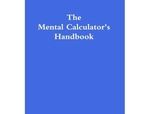
The Mental Calculator's Handbook by Jan van Koningsveld and Robert FountainThere's a book out called The Mental Calculator's Handbook by Jan van Koningsveld and Robert Fountain, which naturally piqued my interest just by the title.

How does this book compare to existing books on mental math? Check out this review and find out!

First, you'll probably want to know what kind of mental math expertise the authors have. Robert Fountain is a British calculating prodigy who was the first of only 3 current International Grandmasters of Mental Calculation.

German mental calculation champion Jan van Koningsveld has held several world records relating to mental calculation, including taking only 3 minutes and 6 seconds to solve 10 problems, each of which involved multiplying two 5-digit numbers. You can find several videos online of his performances, and even if you don't speak German, they're easy to follow due to the numbers and his results being displayed.

At first glance of the contents, The Mental Calculator's Handbook doesn't seem to be much different than, say Arthur Benjamin's The Secrets of Mental Math. The first few chapters cover addition, subtraction, multiplication, division, and fractions.

Once you delve into the chapters themselves, they do begin with basic techniques similar to other books. I was pleased to discover, however, that they do take even these basic techniques farther than most books. The exercises at the end of each section, and the detail given about the techniques is written very clearly, so it's easy to understand.

This early attention to detail and emphasizing the finer points really begins to pay off when you begin learning the techniques in the later chapters, which include working out classic feats such as finding roots, our old friend calendar calculation, and the rarely-discussed factoring of numbers into their prime components.

The section on prime factorization was an especially interesting eye-opener. I was familiar with the basic techniques from my own work on primes in mental math, but the techniques here went much farther. Testing for divisibility by 2, 3, 5, and 9 are simple enough, but when many primes provide a challenge for divisibility tests, such as 7, 11, 13, and 37. The authors turn these into almost trivial challenges by showing how working with much larger numbers, such as 999 and 1,001.

Regular Grey Matters readers won't be surprised to know that I enjoy reading about and working out calendar-related challenges, and even here I was surprised! Besides just the basics of working out the day of the week for any date, you learn how to handle questions such in which years between 2000 and 2099 will Halloween fall on a weekend, and in which months of 1961 the 29th fell on a Sunday.

The Mental Calculator's Handbook winds up with brief biographies of various past mental calculators and their performances. This section especially was a very enjoyable read, and gives you an idea of just what can happen when such feats are demonstrated, and learn the sometimes sad and often amazing ways in which these performer's lives were affected.

If you're not sure of your own interest in mental calculation, I suggest starting with a more basic book, such as The Secrets of Mental Math and see if it's something you'll enjoy. Once you're ready to pursue it further, then you're ready for The Mental Calculator's Handbook, and it's greater attention to detail and mastery of the field. As a matter of fact, this book is a great bridge between the simpler mental math books, and the far more advanced ones, such as Ronald W. Doerfler's Dead Reckoning: Calculating Without Instruments.

Overall, if you're interested in mental math, and want to go beyond the basics, The Mental Calculator's Handbook is an excellent resource to take you to those next steps.

0

Math and Sci-Fi

Published on Thursday, August 01, 2013 in , , , , ,

David Revoy's science fiction artwork from April 2011Perhaps out of necessity, science fiction authors tend to have a better grasp of math than your average fiction author.

I thought it would be fun to take a close look at some of the mathemtical understanding of sci-fi authors, so we can see what happens when these worlds collide.

I'll start with a rather amusing anecdote about John Taine, as posted over on futility closet:

Eric Temple Bell led two lives. By day he was a mathematician at Caltech; by night he wrote science fiction as John Taine.

By a happy chance the two personalities met in 1951, when the Pasadena Star-News asked Taine to review Bell’s book Mathematics, Queen and Servant of Science.

Not one to lose an opportunity, he accepted. “The last flap of the jacket says Bell ‘is perhaps mathematics’ greatest interpreter,’” Taine wrote. “Knowing the author well, the reviewer agrees.”
Speaking of math books, no less than sci-fi author Isaac Asimov wrote a book on mental calculation titled Quick & Easy Math. It's out of print now, but used copies are still available.

Popular Science magazine published a condensed version of that book in its December 1964 issue, which is available online for free now, courtesy of Google books. It runs from pages 77-83, and cover mainly the basic arithmetic operations. The style is very conversational, so the concepts are easy to grasp.

Even when sci-fi authors aren't writing math books, they'll try and sneak in math lessons into their sci-fi works themselves. For example, Arthur C. Clarke snuck an unusual lesson about primes in his book The Garden of Rama. The formula's meaning and importance is explained in the following numberphile video:


If you enjoy sci-fi suthors and their taste of math, the best place to indulge yourself is OMNI magazine, and you can find its full run online for free, courtesy of the Internet Archive. Between their stories, their Games column, and the whole futuristic attitude of the magazine, it's easy to get lost in these pages.

Have fun, and enjoy exploring these resources!

0

Yet Still More Quick Snippets

Published on Sunday, July 21, 2013 in , , , , , ,

Luc Viatour's plasma lamp pictureJuly's snippets are ready!

Instead of trying to pick a theme this month, I decided to return to the original purpose of snippets, and just grab random items of interest to Grey Matters readers:

• For those who enjoyed my post on temperature conversion, and the added trick to make it easier, there are simple tricks for other metric conversions, as well.

Nurse Debra Mallory teaches this simple trick for converting pounds to kilograms. Need to work out a metric distance? Here's a quick trick for converting kilometers to miles.

• Last month's snippets focused on hexadecimal numbers. If you want to learn more about those, check out this introduction to hexadecimal numbers. The approach taught on that page is taught quite clearly, so it's easy to grasp.

• Many of the feats I teach on this site require mental arithmetic. If you want to take your mental math to the next level, check out Aaron Maxwell's online book Inner Algebra: How To Do Algebra In Your Head. The whole book is available at that link, and you can also buy a paperback copy on Amazon.

• Just for fun, and completely unrelated to just about anything else I've ever posted on this site, check out this fun and amazing toy, known as Tumble Rings. You can build them yourself, using several sets of key rings. If you're familiar with the toy known as a Jacob's Ladder, you'll recognize the same principle at work here:


That's it for July's snippets. If you have anything you'd like to add, let me hear about it in the comments below!

0

Review: E-Z Square 6

Published on Sunday, June 30, 2013 in , , , , , , , ,

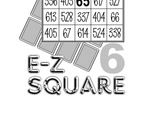
Cover of Werner Miller's E-Z Square 6It seems like Wener Miller just never stops creating!

He's just released E-Z Square 6, the latest in his series of magic square books!

E-Z Square 6 is a bit different from the previous works. Vols. 1-5 each focused on magic squares with a particular theme, such as birthdays, playing cards, and so on. What makes E-Z Square 6 different is that it goes back and updates and improves the methods and routines from past books.

The first routine is an update on the birthday magic square from E-Z Square 1. You start by putting the spectator's age in the center square of a 5 by 5 grid, and then you fill the remaining squares in a seemingly random way. When you're done, the magic total of every row, column, diangonal, and even several cross patterns, total the year the spectator was born! While the effect is the same, the method is greatly improved. Once you have the first few numbers, which is easy enough, the rest isn't much harder than counting.

The next routine is also an update on a bonus, this time on the magic square routine involving a measuring tape from E-Z Square 2. This one is a little sneakier than most of the routines, so it manages to pack an extra punch.

In E-Z Square 5, Werner Miller focused on magic squares with playing cards. The main problem with one of the feature routines, however, is that the resulting 4 by 4 squares usually featured duplicate numbers. In this volume, Werner Miller shows how to solve that problem once and for all, with a little inspiration from Richard Wiseman's The Grid, which also feature playing card magic squares.

Just when you think you've seen everything, the author goes on to teach other playing card magic square ideas with 3 by 3, 4 by 4, and 5 by 5 grids!

This ebook then rounds out with some fun magic square puzzles. One set of puzzles challenges you to cut an existing magic square into 2 smaller magic squares. The other set of puzzles require you to complete magic squares with only a few numbers with which to start. These very same puzzles, I'm proud to say, were first shared by Werner Miller to Grey Matters readers back in 2010 (puzzle 1, puzzle 2, puzzle 3, puzzle 4, answer to puzzle 4).

Technbically, you don't need the previous volumes to get use of E-Z Square 6, but reading this volume will certainly attract your curiosity about all the other routines.

If you're looking for a different take on magic squares, E-Z Square 6, which is also available in German, provides plenty of great routines and food for thought.

0

Mel Stover

Published on Thursday, June 20, 2013 in , , , , , ,

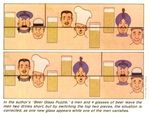
Mel Stover's Beer Glass PuzzleCanadian Mel Stover (1912-1999) was a well-respected magician and puzzle creator whose works all seemed to have both impish and amazing qualities.

His works have been ignored far too long on the pages of Grey Matters, and I'm going to correct that today.

To give you an fun first impression of his work, read Bob Friedhoffer's remembrance of Mel Stover (PDF version). The described puzzle itself is simple enough, but when you're first confronted with it, it seems quite challenging.

Even if you're not familiar with the man himself, you've probably run across his puzzles. Puzzles.com features some of his better known puzzles, and many instantly recognize either the vanishing pencils or the matchstick giraffe right away.

As a matter of fact, Mel Stover developed numerous vanishing puzzles similar to the pencil one above. On this page, the pencils, the beer glasses, and the vanishing leprechaun were all his creations. Watch the vanishing leprechaun in the video below:


My favorite Mel Stover creation has to be what he dubbed the Beadless Abacus. As you can see below, it's an array of hexagonal cells, each containing a simple arithmetic problem. If you were challenged to sum up the answers to, say, any 3 cells in a straight line, could you do it? How about summing a line of 4 cells, or better yet, summing an array of 7 cells (1 in the center, and the 6 cells surrounding it)? Read the article below, and see if you can figure out an easy way to do these.


If you want to verify your answer, or even if you're just stumped, the answers can be found here. The feat above is an excerpt from Games Magazine's The Giant Book of Games, which is available at amazon.com, if you'd like a physical copy.

I hope you've enjoyed this look at some of Mel Stover's creations, and perhaps even found a new favorite magic trick or puzzle to share with others.

0

Predicting Sums

Published on Sunday, June 02, 2013 in , , , , ,

Konrad Jacobs' photo of Martin GarnderIn today's post, we're going to look at a number trick presented by James Grime.

You predict the total of several 4-digit numbers, but don't worry. It's fun, simple, and straightforward.

The following routine is a quick video from the Numberphile series of videos:


The most commonly-used source for this routine is Martin Gardner's book, Mathematics, Magic & Mystery, in which it has the simple title of “Predicting A Sum”. Interestingly, the example number used in the book is 3,845, very close to James Grime's chosen example number, 3,485.

There are many ways to make this routine more impressive. You could employ a secret help, who provides the needed numbers at each step. This takes the heat off of your choices, and makes the whole routine seem fairer, and more impressive.

Another idea to consider is that you don't have to do this as a prediction. Instead, you can do it as a feat of mental arithmetic. Have two people, one of whom is your secret helper, write the numbers down out of your view, and then show the numbers to you briefly. You apparently quickly memorize and calculate the numbers in your head faster than they can do it with a calculator!

With a little creativity, you can think of numerous ways to perform this. Want to seem psychic? Divine the total without ever seeing the numbers (thanks to your secret helper again). You could also perform a routine similar to Scam School's first Pi Day Magic Trick, in which they circle a number, read off the remaining digits, and you can determine the digit or digits they didn't name. Since you know in advance what the total will be, it's all recall with no calculation!

There's a routine with a similar basis called “Alberti's Game”, in which you and two other people randomly choose 3-digit numbers to create 2 multiplication problems, and you're able to predict the sum of the answers to those multiplication problems. Because there's several steps involved, and the answers tend to be large 6-digit numbers, this version seems even more impressive.

How is it done? The answer is below, courtesy of Karl Fulves' Self-Working Number Magic (Amazon link):


Just as with the previous routine, a little creativity, and the possible secret helper, can yield some very amazing results.

Try these out, and if you like them,show your appreciation to Grey Matters by buying Martin Gardner's book, Mathematics, Magic & Mystery and/or Karl Fulves' Self-Working Number Magic. You'll find an amazing variety of number-based magic in both of these mathemagical classics!