Showing posts with label downloads. Show all posts
0

Review: The Knight's Tour: A Scenic Journey

Published on Sunday, August 31, 2014 in , , , ,

Mbdortmund's chess knight photoOne of my favorite mental challenges, as many regular Grey Matters readers know, is the Knight's Tour. The challenge is, using only the chess knight's L-shaped move, to land on each of the 64 squares once.

Mentalist Richard Paddon recently released a download resource titled The Knight's Tour: A Scenic Journey. In this post, I'll take a close look at this new take on a classic feat.

We'll start with a quick peek at Richard Paddon himself performing the Knight's Tour, via the teaser ad:


The Knight's Tour: A Scenic Journey comes as a set of 3 files: A 45-page PDF of the same title, a 16-minute MPEG file of Paddon's performance, and the Knight's Tour Windows application used by Paddon, and programmed by Dave Everett.

In the PDF, right away, the author emphasizes the importance of developing drama in the Knight's Tour presentation. The first parts of the actual instruction, however, focus on developing the path through the board. Much of this part of the book may be familiar to readers of the “Knight's Tour” section of Paul Brook's Chrysalis Of A Polymath. However, Richard Paddon does add some new and helpful notes, such as the section on what he has dubbed “delta values”, which are familiar to those who have programmed a Knight's Tour, but little discussed in the use of performances.

In the next half of the book, Paddon discusses the presentational details. He starts with the benefits of the Knight's Tour, including its uncommon nature, and its huge potential on an emotional and theatrical scale. The thoughts behind the presentations are well laid out. Even if you disagree with any aspect of the presentation as written, you at least have a good starting point of why particular choices were made.

One of the more interesting choices is ending on a selected square, as seen in the above video. As the board empties, the chosen square becomes a more and more important focus, and becomes a natural point of building tension. The PDF winds up with a detailed description of how to use the program.

There are very few weaknesses in this product overall. One of the one that stands out to me as both a programmer and a blogger of mental feats was the choice of the Comic Sans font for the numbering of the board. If you're taking as much care as this author does to make an impact on the audience, there's probably better ways to label your board than a font designed specifically to have a comic-book appearance. On an equally minor note, the lightning in many of the shots of the performance video could be better. The importance of the video is for a more complete understanding of the presentation, so this isn't a huge drawback.

Overall, this is an excellent value for anyone seriously interested in performing the Knight's Tour. The basics of working through the path may be easily accessed in multiple sources, but the depth of knowledge that is presented, as well as the use of multiple media to demonstrate this make this the most complete lessons about all aspects of the Knight's Tour and its proper performance.

It's available for only $9.95 over at Lybrary.com and is a remarkably great value for that money. If the Knight's Tour interests you, Richard Paddon's The Knight's Tour: A Scenic Journey is a must-read.

0

Free Math Magic Books!

Published on Sunday, May 18, 2014 in , , , , , ,

Stewart Butterfield's bookshelf photoLast week, I gave you some free magazines to peruse.

This week, I have some books I'd like to share with you, and they're filled with a great selection of classic mathematical feats and magic!

The first book I'll share with you is a 1952 book titled Mental Prodigies, by Fred Barlow (embedded below). The first section is concerned purely with arithmetical prodigies, or what we might call lightning calculators or human calculators today. The next section discusses related types of prodigies, such as chess or music. Next, is a section on memory, including chapters on famous memorizers, as well as mnemonics and memory techniques for actors.

The chapter I think will be the most interesting to Grey Matters readers is the section on Mental Magic, starting on page 183. It includes many of the standard feats covered here on Grey Matters, such as day for any date, squaring, cubing, and finding roots.

However, there are some more unusual ones, such as calculating the number of farthings in a given number of guineas, or how many barleycorns there are in a given number of yards. Granted, these might not play too well today, but the same technique, as the author explains, can also be used to give the number of minutes in a given number of weeks!

After the embedded book below, scroll down further for another math magic book.


If you'd prefer more than just a few small chapters about mathematical magic, check out the 1950 classic, Math Miracles, by Wallace Lee.

Among the more unusual tricks here are the Ne Plus Ultra Lightning Multiplier and its variations. The Miscellanies chapter is filled with numerous quick and unusual tricks, including the 100 version of our old friend Nim!

I don't want to rob you of the joy of discovery however. Take a chance to page through these e-books, and you may find some unexpected treasures!

0

Free Math Magazines!

Published on Sunday, May 11, 2014 in , , , , , , , ,

Signe Karin’s newsstand photoMany of you are spending today with your mother in honor of Mother's Day, so I won't strain your brain too much today.

In fact, I'll just leave a few free magazines on the table for your perusal when you have some time later.

I'll start with the brand new Recreational Mathematics Magazine. This magazine is available as a whole PDF, or as PDFs of individual articles. The first article that caught my attention here was “The Secrets of Notakto: Winning at X-only Tic-Tac-Toe”. It caught my attention because I'd written about Notakto strategy 2 years ago, including how to win playing on 1 or 2 boards, and then how to win when playing on 3 or more boards.

Don't let me rob you of the joy of discovery, however. The other articles, including the one about Lewis Carroll's mathematical side, the one about vanishing area puzzles, and others are all waiting to be discovered.

The next math magazine I'd like to draw your attention to is Eureka, published by the Archimedeans, the Mathematical Society of the University of Cambridge, since 1939. New issues are being made available online for free by mathigon.org. This is no minor mathematical publication, either. It was the Archimedeans' Eureka magazine that, back in October 1973, had the honor of being the first to publish John Conway's Doomsday Algorithm for calculating the day of the week for any date.

Generally, The College Mathematics Journal isn't available online for free, but they have generously posted the full contents of their January 2012 Martin Gardner issue online for free! It's full of the kind of recreational mathematics which Martin Gardner loved and Grey Matters readers are sure to appreciate and enjoy. There are too many articles to single any one out for special attention, so I suggest jumping in and seeing what catches your eye first!

The final magazine I'll set out for your perusal isn't a mathematical magazine, but rather a magic magazine called Vanish, which is free to download, or read online as a page-flipping e-magazine. The reason I'm including it here with math magazines is because of Diamond Jim Tyler's article on “The Game of 31”. This is variation of our old friend Nim. For a Nim variation, 31 has a surprising amount of its own variations, including a dice version, a finger dart version, and a version which you can still scam someone after teaching them the secret!

That's all for now, so I'll wish you happy reading!

1

How to Solve the Soma Cube

Published on Thursday, February 27, 2014 in , , , , ,

aarchiba's photo of a disassembled Soma cube"Problems worthy of attack prove their worth by hitting back." - Piet Hein, "Problems"

Besides beings known for his short poems, or “Grooks,” Piet Hein is also the inventor of one of the most classic 3-D puzzles: The Soma Cube.

Even if you're not familiar with the name, you've probably seen it. It's consists of several pieces, each made up of 3-4 cubic units, and the basic challenge is to put these pieces together to form a cube.

It was popularized in the US by no less than Martin Gardner, when he wrote about it in his Sept. 1958 “Mathematical Games” column in Scientific American, and later reprinted in his book, The Second Scientific American Book of Mathematical Puzzles and Diversions. Most of the chapter is excerpted here online.

There are numerous versions, the most commonly available today being ThinkFun's Block by Block version. Puzzles.com features links to several do-it-yourself versions, some requiring little more than tape, strips of paper, and a little time. Some of the links there are no longer functioning, but can still be viewed with help from the Internet Archive's Wayback Machine.

Even if you don't already have the puzzle, and don't want to make one, but still want to play around with it, you can play with it on the computer. The version that caught my eye was one that used Google's free 3-D program Sketchup. Once you learn the basics of rotating and moving objects in Sketchup, and download a free set of Soma Cubes for the program, you're ready for the challenge.

I haven't yet discussed solving the classic Soma Cube challenge, so if you want to solve it for yourself without learning how to solve it, stop reading NOW.

You're still here? OK, then I assume you want to learn how to solve it, and more importantly, how to remember the solution. YouTube user MisterCorzi has posted probably the best Soma Cube solving video I've seen, as it emphasizes the points that make the solution easy to recall:


Once you have the basic idea, here's a diagram of MisterCorzi's approach, for quick and easy reference:

Dmitry Fomin's Some Cube solution image

I should emphasize that this is only 1 of 240 possible ways (not including rotations or reflections) to solve the Soma Cube, so you can still find plenty of challenge by trying to find the other solutions. There are also many other shapes you can try to make, so create, have fun, and explore!

0

Yet Still More Quick Snippets

Published on Thursday, January 23, 2014 in , , , , , , , , , , ,

Luc Viatour's plasma lamp pictureFor January's snippets, I'm featuring an unusual mix.

This time around, I've got 3 different things for you: Math, memory...and Macs?!?

• Numberphile took a breather from their usual number videos to do something a bit different. They interviewed UC Berkeley professor Edward Frenkel with the question, “Why do people hate mathematics?” It's an interesting topic and well worth your time:


• In the video above, they talk about the important roles of math teachers. Longtime Grey Matters readers know that I'm not just a big proponent of memorizing, but rather memorizing along with understanding. Above and beyond great sites that aid in mathematical understanding, such as BetterExplained and Plus magazine, there's also an excellent free ebook called Nix The Trix. It's aimed at students who are great with shortcuts, but never took the time to understand the foundations of what those tricks are actually doing. It can help teachers undo the damage by showing how to teach the actual mathematical basis, which is also a great help in understanding when to use the math tricks.

• Almost just in time for this month's snippets, Reddit featured an interesting and popular thread asking, “What are some things worth memorizing?” Yes, of course, there are the usual array of sarcastic and silly answers, but if you take the time to wade through some of the roughly 12,000 comments (at this writing), there are some great ideas. I won't rob you of the joy of discovery, especially as the reply you most enjoy may not even exist yet as I write this!

• If you've ever memorized something with the help of spaced learning, where the concept you're trying to memorize is reinforced 3 times at spaced intervals, you know how powerful it can be. There's now an online web service called MemStash which help you do this almost automatically. You save things you wish to remember by highlighting them in an online page, and then clicking a special MemStash bookmarklet. After that, they'll send you 3 reminders at spaced intervals, which can help you recall what you saved!

• OK, this last snippet isn't really along the usual Grey Matters topics, but I thought it would be fun to sneak it in. 30 years ago this week, the Apple Macintosh computer first came on the market. During Super Bowl XVIII on January 22, 1984, they aired their now-classic 1984 ad, announcing the upcoming release of the Macintosh on January 24th. The lesser-known January 24, 1984 introduction of the Macintosh has also been preserved on video:


That's all for this month's snippets. I hope you enjoy them!

0

Still More Quick Snippets

Published on Sunday, December 15, 2013 in , , , , , , , , , , ,

Luc Viatour's plasma lamp pictureIt's time for December's snippets.

I've noticed the simpler, more direct skills prove popular, so this month will feature more skills you can learn, use, and demonstrate quickly.

• We'll start off with a simple skill: figuring out your longitude by looking at the night sky, assuming you're in the northern hemisphere. First, you need to find the star Polaris, which is why you need to be in the northern hemisphere for this to work. If you don't know how to do that, my post from September about learning to find various stars will be of help here.

The next step is to determine how many degrees above the horizon Polaris is located. This post from One Minute Astronomer shows how to measure the approximate angle using only your hands! This is a fun skill to demonstrate and teach, as well.

• From arrangements of stars, we come down to earth to arrangements of numbers. Michael Daniels, over at mindmagician.org, has posted a new magic square generator which can handle any integer from 34 through 9999. If you're curious about the method used to create these, you can learn more about it in his ebook, Mostly Perfect. You can even download free excerpts from the book for free!

• One of my favorite feats, the calendar feat, is taught in a very simple and direct version in the following video from Mister Numbers:


If you're not already familiar with Mister Numbers' work on YouTube, check out his channel, and see some of his other work in number patterns. He details more about this calendar procedure in his Kindle ebook, Amazing Calendar Math Magic.

This method has it roots in John Conway's Doomsday Method, and I show how to build on this basis in a simple way to handle almost any year in my ebook, Day One.

• Also from Mister Numbers, here's an impressive video that quickly teaches kids, or anyone really, to be able to handle multiplying the numbers from 1 to 40, and beyond, by themselves in a simple way:


I take advantage of this same basic pattern in my lessons on extracting the roots of perfect squares over in the Mental Gym, so this is a very useful pattern to know!

I hope you've found something quick an interesting. Have any quick and interesting math tips or patterns of your own? I'd love to hear about them in the comments!

0

It's All About The Benjamin

Published on Sunday, November 10, 2013 in , , , , , , , , , , ,

Procsilas Moscas' number grid pictureEven if you're not into mathematical magic and mental math, you're probably familiar with Dr. Arthur Benjamin from one or more of his TED talks.

Another video of his mathemagical feats has surfaced on the web, but this one includes the methods of each routine!

This video lecture is titled The Magic and Math of Mental Calculation, and was held at the 2013 Martin Gardner Celebration of Mind in Washington DC, courtesy of the Mathematical Association of America and Math For America-DC.

The Magic and Math of Mental Calculation is done in full lecture style, and runs about 78 minutes. It is introduced by MAA's Ivars Peterson and Thinkfun (Amazon.com link) CEO Bill Ritchie:


Granted, the single unmoving camera angle could make things hard to follow, but I've gathered numerous links which I hope will make everything clearer.

First, Ivars Peterson mentions that April is Mathematics Awareness Month, with the 2014 theme being Mathematics, Magic and Mystery, after the Martin Gardner book of the same name (Amazon.com link).

Dr. Benjamin starts out by squaring 2-digit numbers in his head. This feat is relatively easy to learn, and the Mental Gym even features a 2-digit squaring tutorial and quiz. The later explanation features some excellent advice on working up to squaring 3- and 4-digit numbers.

This is followed by the missing digit feat, which is explained much later in the video, so I'll come back to it.

Next up is a magic square feat. The explanation can be tricky to follow. Fortunately, Dr. Benjamin has posted the instructions for his Double Birthday Magic Square online for free. There are several essential tips in the video that make the performance of this far better than if you'd just learned from the PDF alone.

When he talks about how he developed the magic square routine in the first place, he mentions a 2003 magic square article in a magic magazine. This seems to be Harry Lorayne's article, 4×4 Magic Square Breakthrough??. The original magazine article isn't easy to find, but the entire article was reprinted in Harry Lorayne's book, Mathematical Wizardry (Amazon.com link), which I reviewed here back in 2006.

The calendar feat, as many Grey Matters readers already know, is a favorite of mine. You can follow along Dr. Benjamin's somewhat brief explanation of the feat with the help of the Day of the Week For Any Date tutorial and quiz here. I have done my own work simplifying the calendar feat in my Day One ebook.

Impressively, Dr. Benjamin even fields a question about mentally determining whether a 3-, 4-, or 5-digit number is prime or not, despite not performing any feats related to this. If you're wondering why he's using this particular approach, my prime number testing post from earlier this year may make things clearer.

Coming back to the discussion of the missing digit feat, it's hard to make this much clearer than it is on the video. There is the amusing question of whether zero is an even number, which Numberphile tackled in one of their videos.

Dr. Benjamin also discusses here what to do when you're not sure whether the missing digit is a 0 or a 9. My preferred approach here would be to say, “I'm not getting anything. It wasn't a zero, was it?” Note that by making this a negative question, you can follow up their answer with “I thought so” or “I didn't think so”, which makes you sound like you knew all along, even though you're just asking a question.

The lecture is wrapped up with the mental multiplication of 2 five-digit numbers. This isn't done as quickly as the other squaring feats. Instead, this is done with lots of verbal calculation and what seems to be some nonsensical words thrown in. First, as he explains after getting the number 37,947 to square, he points out that he's going multiply 37,000 by 947, double that number, square 37,000, square 947, and add all those results together.

Why is he doubling that first calculation? Effectively, he's breaking the problem down into (37,000 + 947)(37,000 + 947). As with any problem of the form (a + b)(a + b), Wolfram Alpha shows that the result must be a2 + 2ab + b2.

The mysterious words he's uttering are actually ways of remembering numbers. Arthur Benjamin has another free lecture available online that details how to memorize numbers like this.

As with many live lectures, this one winds up with several mentions, including that of Harvey Mudd College, where Dr. Benjamin teaches.

Several of Dr. Benjamin's books and DVDs are promoted in the lecture. Since Grey Matters is an Amazon.com affiliate, you can help support this blog by buying Dr. Benjamin's books through our affiliate link, his Secrets of Mental Math DVD (from which the above free number memorization lecture is taken), his Joy of Mathematics DVD, and/or any of the Amazon.com links listed above.

0

Numerous Wonders

Published on Monday, November 04, 2013 in , , , , , , , , ,

Shreyas Patil's photo of playing cardsIt's time for some magic!

Don't worry, there's no complicated sleight-of-hand in these tricks. Not only does math make them easy, but you don't even have to do any math during the routines, since all the math involved has been worked out ahead of time.

I'll start with the simpler of the tricks. In this first one, you have someone think of any hour of the day, and you tap numbers on an analog watch while they silently count up to 20. When they reach 20, they say “Stop!”, and your finger is on the hour they secretly chose!

The method behind this simple trick is described in Futility Closet's On Time post.

At first, the workings may confuse you, but a little experimentation with different numbers will help you understand it. Obviously, this is also true for anyone for whom you perform it, so don't treat this as a big mystery, but rather as a simple and interesting experience.

The basic tapping presentation has a long history in magic. In Martin Gardner's book, Mathematics, Magic and Mystery, there's an entire section on tapping tricks. Thank to Google Books, you can read the entire section online for free, running from page 101 to page 107.

The next trick, courtesy of Card Colm, is a little more involved. You have someone name any card suit, have a regular deck of cards shuffled, and then the number cards (Ace through 9) are removed in the order in which they're found in the deck. You then make an unusual bet based on divisibility of various numbers formed by those cards.

This trick is called the $36 Gamble, and the method is found in Card Colm's post, The Sequence I Desire. Magic: When Divided, No Remainder. Beyond just the mathematical method, there's plenty to explore under the hood of this routine, including Arthur Benjamin's method for determining divisibility by 7, and a very deceptive shuffling method, which appears fair.

If you enjoy the deceptive shuffles discussed in the above post and its links, you also might enjoy Lew Brooks' book Stack Attack, which features the False False Shuffle. The false shuffle and the routines in Stack Attack mix well with the principles behind the $36 Gamble. In my 2006 review of the DVD of the same name by the same author, you can get a better idea of the contents.

Even though I've only linked to 2 tricks here, practicing them, understanding them, and digging in to the variations I've mentioned is more than enough to get your mental gears turning, so have fun exploring them!

0

142857 And So On...

Published on Monday, October 28, 2013 in , , , , , ,

Melchoir's, AzaToth's, Mets501's, and Sopoforic's 0.999 perspective imageIf you've ever done decimal division, you've no doubt run acros numbers that endlessly repeat, such as 0.333 0.666.

If you've ever dealt with decimal division by 7, as taught in my Mental Division With Decimal Accuracy post, you've noticed an unusual phenomenon that goes just beyond the repeating of the digits. It's that odd quality we're going to discuss in today's post.

When you divide 1 by 7, you get the number 0.142857142857... and you notice that the digits repeat endlessly. Even weirder, thought, is the fact that dividing 2 by 7 gives you the same digits in a different order: 0.2857142857142857.... and so on. In fact, as discussed in the mental division tutorial, dividing any number from 1 to 6 by 7 will always return the same digits with only the starting point changing.

Numberphile recently turned its attention to the number 142857, and explains many of the unusual qualities behind this and similar numbers:


Let's take things a step further than in the video above. If we arrange the multiples of 142857 from 1 to 6 in order, we get the following square:

1 4 2 8 5 7
2 8 5 7 1 4
4 2 8 5 7 1
5 7 1 4 2 8
7 1 4 2 8 5
8 5 7 1 4 2
Now, since each row contains the same numbers, it shouldn't be surprising that each row gives the same total (27, as it happens). When you realize that 7 times 142857 is 999999, then it's not difficult to understand that 1 times 142857 plus 6 times 142857 would total 999999, as well. The same is true of 2 times 142957 plus 5 times 142857, and 3 times 142857 plus 4 times 142857. This means that all the columns will give the same total of 27 as well.

This is almost like a magic square! In a true magic square, however, the diagonals would also give the same total. Sadly, in the above square, the left-to-right diagonal totals 31, and the right-to-left diagonal totals 23. This still makes it what it known as a semi-perfect magic square.

Because of the unusual nature of these cyclic numbers, all numbers will have a similar quality. Is it possible, though, that a true magic square can be formed this way?

The answer is yes, it can be done! On page 176 of W. S. Andrews' Magic Squares and Cubes, the author shares Harry A. Sayles' perfect magic square using 19ths:
01/19 = .0 5 2 6 3 1 5 7 8 9 4 7 3 6 8 4 2 1
02/19 = .1 0 5 2 6 3 1 5 7 8 9 4 7 3 6 8 4 2
03/19 = .1 5 7 8 9 4 7 3 6 8 4 2 1 0 5 2 6 3
04/19 = .2 1 0 5 2 6 3 1 5 7 8 9 4 7 3 6 8 4
05/19 = .2 6 3 1 5 7 8 9 4 7 3 6 8 4 2 1 0 5
06/19 = .3 1 5 7 8 9 4 7 3 6 8 4 2 1 0 5 2 6
07/19 = .3 6 8 4 2 1 0 5 2 6 3 1 5 7 8 9 4 7
08/19 = .4 2 1 0 5 2 6 3 1 5 7 8 9 4 7 3 6 8
09/19 = .4 7 3 6 8 4 2 1 0 5 2 6 3 1 5 7 8 9
10/19 = .5 2 6 3 1 5 7 8 9 4 7 3 6 8 4 2 1 0
11/19 = .5 7 8 9 4 7 3 6 8 4 2 1 0 5 2 6 3 1
12/19 = .6 3 1 5 7 8 9 4 7 3 6 8 4 2 1 0 5 2
13/19 = .6 8 4 2 1 0 5 2 6 3 1 5 7 8 9 4 7 3
14/19 = .7 3 6 8 4 2 1 0 5 2 6 3 1 5 7 8 9 4
15/19 = .7 8 9 4 7 3 6 8 4 2 1 0 5 2 6 3 1 5
16/19 = .8 4 2 1 0 5 2 6 3 1 5 7 8 9 4 7 3 6
17/19 = .8 9 4 7 3 6 8 4 2 1 0 5 2 6 3 1 5 7
18/19 = .9 4 7 3 6 8 4 2 1 0 5 2 6 3 1 5 7 8
In this square, all of the rows, columns, and diagonals each total 81!

As an aside, numbers such as 19 have many more interesting qualities for division. To get a better idea of what I mean, check out my Leapfrog Division post.

I'll leave your mind boggled at this point, but I will suggest you do an internet search for the number 142857, as there are still more amazing qualities to discover!

0

Geogebra Comes To Tablets!

Published on Sunday, September 29, 2013 in , , , , , ,

Proferichardperez' drawing with several images representing different areas of mathematicsIf you've read even a little of this blog, you know I love playing with math.

Naturally, when mobile apps are released that let me play with math on the go, I'm even more enthused! Earlier this month, an app called Geogebra was released, and it's a great way to explore math visually!

Geogebra is what is known as a computer algebra system, or CAS, for short. As you input various mathematical equations, you get a visual representation. The video below gives you a better idea of how Geogebra is used. While it focuses on the original online version, much of the operation is the same in the new versions:


The tablet versions of Geogebra were announced on Sept. 1st, and are available for Android, iOS, and Windows 8 tablets. Take the time to explore the other links on that page, as there's great support for the program in the form of a community, examples, videos, and much more!

If you already use the Wolfram|Alpha app on your tablet, Geogebra makes a nice compliment to it, for those who enjoy exploring math.

0

Review: E-Z Square 6

Published on Sunday, June 30, 2013 in , , , , , , , ,

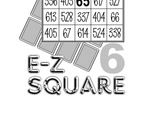
Cover of Werner Miller's E-Z Square 6It seems like Wener Miller just never stops creating!

He's just released E-Z Square 6, the latest in his series of magic square books!

E-Z Square 6 is a bit different from the previous works. Vols. 1-5 each focused on magic squares with a particular theme, such as birthdays, playing cards, and so on. What makes E-Z Square 6 different is that it goes back and updates and improves the methods and routines from past books.

The first routine is an update on the birthday magic square from E-Z Square 1. You start by putting the spectator's age in the center square of a 5 by 5 grid, and then you fill the remaining squares in a seemingly random way. When you're done, the magic total of every row, column, diangonal, and even several cross patterns, total the year the spectator was born! While the effect is the same, the method is greatly improved. Once you have the first few numbers, which is easy enough, the rest isn't much harder than counting.

The next routine is also an update on a bonus, this time on the magic square routine involving a measuring tape from E-Z Square 2. This one is a little sneakier than most of the routines, so it manages to pack an extra punch.

In E-Z Square 5, Werner Miller focused on magic squares with playing cards. The main problem with one of the feature routines, however, is that the resulting 4 by 4 squares usually featured duplicate numbers. In this volume, Werner Miller shows how to solve that problem once and for all, with a little inspiration from Richard Wiseman's The Grid, which also feature playing card magic squares.

Just when you think you've seen everything, the author goes on to teach other playing card magic square ideas with 3 by 3, 4 by 4, and 5 by 5 grids!

This ebook then rounds out with some fun magic square puzzles. One set of puzzles challenges you to cut an existing magic square into 2 smaller magic squares. The other set of puzzles require you to complete magic squares with only a few numbers with which to start. These very same puzzles, I'm proud to say, were first shared by Werner Miller to Grey Matters readers back in 2010 (puzzle 1, puzzle 2, puzzle 3, puzzle 4, answer to puzzle 4).

Technbically, you don't need the previous volumes to get use of E-Z Square 6, but reading this volume will certainly attract your curiosity about all the other routines.

If you're looking for a different take on magic squares, E-Z Square 6, which is also available in German, provides plenty of great routines and food for thought.

0

More Quick Snippets

Published on Sunday, April 14, 2013 in , , , , , ,

Luc Viatour's plasma lamp pictureIs it time for April's snippets so soon? It only seems soon because March's were so late.

This month, the focus is on resources which help you remember more effectively!

• Just today, Forbes.com posted a wonderful article titled 6 Easy Ways to Remember Someone's Name. In addition to the standard advice, I especially like the tip of asking them a question, so you can take some time to mentally link their name with their face.

If you want to examine this in more detail, I've prepared a YouTube playlist focusing on memorizing names and faces. There's also an excellent book titled How to Remember Names and Faces: How to Develop a Good Memory (originally published in 1943, but the advice is still very sound!). I've also covered various mobile apps that help you practice these techniques.

• Speaking of apps, there's a new free iOS app called Brain Athlete (iTunes link). This focuses on memory-competition feats, including memorizing numbers, word lists, and playing cards. If you've read Joshua Foer's Moonwalking With Einstein and/or read my PAO system post, you should have a good understanding of the basics.

If you get stuck finding a certain person for your PAO system, here are links to lists totaling 10,000 famous people to help. No actions are objects are included, as these need to be developed based on how you imagine each of these famous people.

• Every so often, I run across free memory web apps that I find useful, such as these. The newest one I've found is the Major System Database. It's very simple and direct. You can find words for a given number, the numeric equivalent of a given word, or even break up numbers into small groups and give you mnemonics for each group!

• For Windows users, there's a new free program available, simply titled Memorization Software. It's designed to help you remember various types of texts, such as lyrics, poems, and speeches word for word. The tutorial video below (no audio) gives you an idea of the various approaches used here.


If you like this approach, but don't have a Windows machine (or even if you do!), my web app Verbatim 2 (Video Tutorial link) is also free, works in a similar manner, and runs in any modern browser.

0

Werner Miller's Sub Rosa 3 and 4

Published on Sunday, March 24, 2013 in , , , , ,

Cover of Werner Miller's Sub Rosa 1 and 2If you're familiar with Werner Miller's work, you're in for another treat from him!

If you're not familiar with Werner Miller's work, you're in for several treats!

For those not familiar with him, he's a creator of mathematical magic from Germany. What makes his work so special is his knack for ingeniously and effectively disguising the mathematical principles used in his routines. If you haven't already done so, go back through this site to explore some of his other effects. You'll quickly get an appreciation for his style of thinking.

Last October, he released the first two volumes in a new series called Sub Rosa (Latin for in strictest confidence). Earlier this month, Werner Miller released two new books in the series, Sub Rosa 3 and Sub Rosa 4.

Thanks to the math involved, none of the routines require any difficult sleight-of-hand. For example, one of the routines from Sub Rosa 4 is titled, “ESPecial Countdown,” and performed with ESP cards. After the ESP cards are mixed, an audience member chooses a card. This card is set aside face down, and no one, not even the audience member, knows which ESP symbol was chosen.

The performer then removes 8 cards, and asks for a number (8 or less) from which to countdown. The performer then runs through a procedure in which the cards are counted down. When the countdown reaches 0, the card at that position is removed. Interestingly, it proves an exact match for the card previously chosen by the spectator.

Generously, Werner Miller has allowed me to reveal the method to “ESPecial Countdown” here on Grey Matters. The method is explained below, and the PDF can be downloaded via this link.


I'd like to thank Werner Miller for his generosity in letting me share this routine with you. If you'd like to show him your thanks as well, you can buy Sub Rosa 3, Sub Rosa 4, and his other works over at Lybrary.com.

1

A Long Maze Journey

Published on Sunday, January 06, 2013 in , , , ,

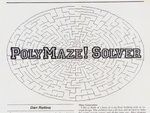
Dan Rollin's Polmaze! Solver articleBack when I first got into computers, I ran across a maze program in a magazine called Creative Computing. The clarity with which the maze algorithm was explained astounded me, especially considering the complexity.

This program actually had a surprising effect on much of my life, and appropriately enough, the story is filled with as many twists and turns as the mazes the program generates.

The first computer I ever owned was a Commodore 64, which I received for Christmas in 1982. I ran across the maze program that captivated (yes, I'm trying to avoid using the word amazing) me about a year later.

However, I didn't understand enough of the math or the Commodore 64's high resolution mode to translate the program. Writing the program would have to wait for another 5 years, until I got into a college whose computer lab had an Amiga.

After just being a pipe dream for 5 years, actually writing and solving the mazes was thrilling! I remember thinking that this program had been well worth the wait. In 1989, just a month before I finished saving for my own Amiga, I accidentally left the floppy disk and the magazine in the computer lab and never saw them again. I even checked with the computer lab's and school's lost-and-found dept. every day for the next week, but I then accepted it was gone.

It had been in the back of my mind for so long, though, that it managed to stay in my head for a long time after that. In 1993, when I found a book titled The Best of Creative Computing, Vol. 1, I immediately flashed back to the maze program, and bought it hoping it would be in there. Unfortunately, it wasn't.

A short time later, I ran across The Best of Creative Computing, Vol. 2 and had the same hopes, but the program wasn't included there, either. By the time I went back for The Best of Creative Computing, Vol. 3, the store no longer offered it, and I couldn't help but think that, with my luck, that the maze program would be in there.

At this point, the only details I remembered was that it was in Creative Computing and that it was a maze program. I didn't think of it again until 2006, when someone on a forum asked about computer algorithms for mazes. That got me searching for it online. I managed to find all 3 Best of Creative Computing books online for free and immediately plowed through Vol. 3, only to discover the program wasn't there, either. It did get me thinking about it again, and I'd search for the program online whenever it popped into my head.

In 2008, I came amazingly close when I discovered the full text of the article online at atarimagazines.com. It didn't include the helpful illustrations or the program listing I wanted, but it was a thrill just to read the explanation again. As an added bonus, I finally knew that the article had come from the December 1983 issue of Creative Computing, had started on page 294, and that it was written by Dan Rollins, who titled it Polymaze! Solver.

With the name, I tried more exact searches, but nothing showed up. Last year, when I first discovered archive.org's computer magazine archives, Creative Computing was the first thing I looked for, but it wasn't there.

Finally, late last month, I noted Creative Computing had finally been added. At that point, the December 1983 issue wasn't available, but at least they were actively adding issues. On New Year's Eve, October 1983 showed up, and on New Year's Day, November 1983 showed up. The suspense was killing me. Sure enough, on January 2nd, after 24 years of searching, I had finally found December 1983 issue of Creative Computing, including Polymaze! Solver complete with illustrations and program listings (found on pages 294-311)!

You're probably wondering what it was about this program that captivated me for 3 decades. As you can see from this blog, I love having fun with math, and this article did just that, and seemed to keep going and going! It started by showing how to randomly generate a rectangular maze so as to guarantee only one possible solution, then showed how to “stretch” the right side of the maze around to meet the left side, and it even taught an algorithm that allowed the computer to find the solution. I had never seen so much math put to such amazing and creative use!

Being able to access the magazine online has proved to provide an added bonus. Dan Rollins mentions some of his other articles at the start of the article, and now I can finally read those, as well. His other articles include Kwikmaze (80 Micro, November 1982), Bee Amazed (Creative Computing, June 1981) and Pocket Computer Fun (Creative Computing, December 1982).

With access to the original BASIC program, I'm now thinking it wouldn't be too hard to translate this into Javascript, especially for HTML5 browsers. Not only would it be a fun challenge to get it working on the web, but also playing it on the web, as well.

Once the various original features are working, there's still room for creativity. For example, if you remember games such as Doom and Duke Nukem, those used a technique called ray casting to create a quick-and-dirty realtime 3D experience. With a few lessons in ray casting math and some some ray casting lessons specifically in Javascript, this maze could have a whole new life.

Take the time to look around the resources and explore, especially if you're into computer programming. Magicians have a saying that applies here: “If you want to create something new, start by examining something old.”

1

Free Math Magic!

Published on Sunday, December 09, 2012 in , , , , , , , ,

Free Mathematical Magic eBooks from Peter McOwan and othersIt seems British Magician and math professor Peter McOwan, with help from a few others, has been busy putting together an astounding array of mathematical magic in recent years.

They've made all these works available in the form of e-books and videos, and generously posted them all on the web for free! In this post, I'll let you know where you can find this amazing body of work.

• Manual of Mathematical Magic: Regular Grey Matters readers will already known about this book by Peter McOwan and Matt Parker, since I wrote about it back in June.

This book is very well organized. The tricks are taught in sections by the type of math involved, such as arithmetic, algebra, geometry, and so on. Each trick is subdivided, as well, into the trick as it appears to your audience, the method behind the trick, the math behind the method, and even where to find the same type of math in your everyday life!

There is a nice build to this manual. Early on, you learn a few routines that are simple, and you often find that later routines build on these simple skills.

• The Magic of Computer Science, Vols. I and II: With a daunting title like The Magic of Computer Science, you might worry about whether these volumes would be filled with complex math and special programs. Fortunately, both of these volumes are a lot more human-friendly.

Volume I, in fact, teaches computer concepts using only a deck of cards. It's amazing how you can start from a trick in which you predict the total of 4 cards chosen by the audience, and then learn that this trick's principle is what makes CAT scans possible!

Volume II also uses cards quite a bit, but also has tricks with other props. There's an amusing and amazing vanishing robot routine, using a downloadable graphic available on this page. My favorite routine in this book, however, is “The Power of Prophecy,” in which someone takes a number of cards from the deck without you peeking, yet you can apparently divine how many they've taken. Even if you're familiar with this routine from other sources, the related lessons in algebra and modeling systems are worth reading.

• Maths Made Magic: This book is clearly designed to appeal to the Harry Potter crowd, right down the visual design. It's made to look like it was printed on old, yellowed paper, and presents the routines as if they were spells and sorcery.

The methods, all real-world mathematics, are explained simply, yet still manage to teach advanced concepts quite well. As a matter of fact, Maths Made Magic uses more advanced math than many other math magic resources I've come across. It's not often you see magic tricks that help you understand sine and cosine, or simultaneous equations mixed with the Pythagorean theorem.

• Mathematical Magic: Mathematical Magic isn't an ebook. Instead, it's an iTunes U course, playable through iTunes on your computer, or the iTunes U app on an iOS-based mobile device.

Besides the medium, the Mathematical Magic course is different in that not every routine is explained (Don't worry, most of them are explained). Knowing that all the routines are math-based, though, I like the fact that not all the tricks are explained. It's a sort of test of your observation and critical thinking skills that have hopefully been developed by reading and trying out the other routines.

• Illusioneering: Clever Conjuring Using Secret Science & Engineering: If you're ready to get away from cards and pure mathematics, there's still plenty of magic to be had use scientific principles. Illusioneering features magic with liquids, wheels, balloons and other assorted props.

The math is still there, underlying the science, but these tricks tend to play bigger and be more visual than those in the previous books. The Illusioneering homepage also features videos of many of the effects (including their methods), as well. The Illusioneering book and videos are also available via iTunes U.

The price is certainly right, so take some time to download these resources, explore, and have some fun!

0

98 Years of Martin Gardner

Published on Sunday, October 21, 2012 in , , , , , , , , ,

Konrad Jacobs' photo of Martin GarnderOn October 21, 1914, Martin Gardner was born. After having an enormous and positive effect on the fields of magic, mathematics, philosophy, literature, science, and many other fields, he died on May 22, 2010.

On the 98th anniversary of his birth, I thought it would be fun to look back at Martin Gardner's influence.

Back in 1956, Martin Gardner submitted an article on flexagons to Scientific American. They not only ran the article, but offered Gardner his own monthly Mathematical Games column. The first column ran in January of 1957, and he kept it going regularly for the next 25 years! Martin continued to write the occasional column until the May 1986 issue, retiring both himself and the column.

In honor of the flexagon column that started it all, and Martin Gardner's birthday, Vi Hart has dubbed October 2012 the month of the flexagon. Below is the first video she made to honor this month:


Vi Hart also made a second video on their surprising mathematical qualities, and even a third on flexagon safety.

All of Martin Gardner's columns were assembled into a series of 15 books. The books themselves have since been assembled into the Martin Gardner's Mathematical Games CD-ROM. This series of PDF eBooks is searchable and portable, making the joy of surprise and discovery even more accessible.

Even though it's Martin Gardner's birthday, you can get a few free goodies to get an idea of his influence. The January 2012 issue of the College Mathematics Journal was entirely dedicated to his work, and remains free to download as either the full issue or individual articles. The Gathering 4 Gardner Foundation has several Martin Gardner posters available for free download, and even a full free PDF copy of a tribute book called The Mathematician and the Pied Puzzler.

Probably one of the most famous Gathering 4 Gardner giveaways, thanks largely to this YouTube video, would be the paper dragons whose heads seem to turn and follow you. The PDFs that will let you build your own green dragon, red dragon, and/or blue dragon are still available as free downloads.

Many of the puzzles he created and/or popularized over the years can be found in Puzzles.com's Martin Gardner section. It's surprising how many now-classic puzzles can be traced back to him. He even gets a mention in Bill and Ted's Excellent Adventure:

[Bill and Ted are working on their history report]
Bill: Okay, Ted, George Washington. One: the father of our country.
Ted: Two: born on President's Day.
Bill: Three: the dollar-bill guy.
Ted: Bill, you ever made a mushroom out of his head?
That mushroom reference is to a puzzle originally published in Martin Gardner's April 1968 column on dollar bill puzzle, and later reprinted in both Mathematical Circus, as well as Perplexing Puzzles and Tantalizing Teasers (solution can be found here).

Even today, people are help keeping Martin Gardner's memory alive. Besides the Gathering 4 Gardner Foundation above, you can also follow @WWMGT on Twitter. WWMGT stands for “What would Martin Gardner tweet?”, and the author does an excellent job of living up to that title.

I'll wind this with a full 1996 episode of David Suzuki's The Nature of Things which focused on Martin Gardner. It gives a great idea of not only his life, but his legacy, too:

0

Werner Miller's Sub Rosa 1 and 2

Published on Sunday, October 07, 2012 in , , , , , ,

Cover of Werner Miller's Sub Rosa 1 and 2In the past, Werner Miller has generously shared his creative brand of mathematical magic with Grey Matters readers numerous times.

He's just released two new books, Sub Rosa 1 and Sub Rosa 2, and has allowed Grey Matters readers to take a free peek at an effect from the book.

Sub Rosa is Latin for “in the strictest confidence.” In Werner Miller's case, it also means a multi-volume series of books containing a treasure trove of deceptive and original mathematical-based magic, none of which requires any difficult sleight-of-hand.

In Sub Rosa 2, there's an effect called Latin ESP square. You shuffle a set of standard ESP testing cards, and then have the spectator cut the cards. You then deal them out without looking at the faces, so that no row, column, or diagonal contains duplicates of any symbol!

The method is described below, and you can download this PDF at this link.


In the description above, you start by giving the deck a special type of shuffle. You can learn that shuffle in just a few minutes via this YouTube tutorial. When using it with just 25 cards, it's very deceptive. Although it looks like a very thorough mixing procedure, the only effect it has is the same as a cut.

Beyond just setting up an amazing pattern, this is also a great way to secretly set up a Latin square for a subsequent trick. Colm Mulcahy, whom I wrote about just last month, has some excellent trick involving Latin square set-ups, including Splitting the Pot and Amazon Arrays (Large Action). You can find much more about Latin squares on the Mathematical Association of America's website.

Thanks again to Werner Miller to allow Grey Matters to share this great routine. For more of this ingenious thinking, check out Sub Rosa 1 and Sub Rosa 2, as well as his other works!

0

Age Cards: Game Show Theme

Published on Thursday, October 04, 2012 in , , , ,

LaMenta3's binary pillow photoIn the Age cards discussion in my previous post, I tried to spark ideas about creating your own original versions. If you haven't already seen it, I recently added a James Grime video to that post, about other approaches to the Age Cards using sets such as Fibonacci numbers and prime numbers.

Brian O'Neill recently e-mailed me his brilliantly conceived variation of the Age Cards. In my opinion, it makes the routine more deceptive, as well as engaging for the audience.

Brian's idea has several layers to it. First and foremost, he's given it the theme of a popular game show that involves choosing from numerous suitcases.

Thanks to this theme, there's now a reason that not all numbers are visible on the card. As you see below, it's designed as if some of the suitcases are open, with prize amounts showing, and others are closed, with their suitcase numbers displayed. The logic here is clear and consistent with the audience's expectation.

You can have someone think of any suitcase, numbered 1 through 26, and use the standard Age Cards procedure (noting the bottom-leftmost visible number on each card) to divine that number. Already, this is not a bad trick, but Brian has ingeniously added another level to his version.

You can also have someone think of any of the prize amounts shown on the last card, and divine the spectator's prize amount, as well! The method here is a little different.

When you have someone think of a prize amount, add the bottom-leftmost visible suitcase numbers of the cards on which they see their prize amount, just as you would for the suitcase-number version.

Once you have that number, however, the last image listing all the prize amounts becomes your secret key. You'll have a number from 1-24, and that will tell you where on the list to look for their prize amount. The amounts in the left column ($1 to $1,000) correspond to the number 1 through 12 (respectively, from top to bottom), and the amounts in the right column ($5,000 to $1,000,000) correspond to the numbers from 13 through 24 (again, respectively from top to bottom).

For example, if someone was secretly thinking of $300,000, they'd note that they see that amount on the 3rd card (lowest number showing: 4), and the 5th card (lowest number showing: 16). In this example, you'd add 16 + 4 to get 20. Since 20 is higher than 12, you'd look on the right side of the prize amount list (the easiest thing to do in this example is to count backwards from 24 starting at the bottom). Sure, enough, the 20th prize amount on the list is $300,000!

When performing this for two people at the same time, you'll want to prevent the confusion of calculating two separate totals at the same time, so have the first person think of a suitcase number, and go through asking them about the cards on which they see their number, then turn to the 2nd person and have them think of the prize amount. This way, you complete one total before starting another one. You still have to make sure and remember both totals, as well as to whom they apply.

Download each of the images below, and try it out for yourself. Thank you once again, Brian, for your creativity, and your willingness to share!


0

New Goodies in the Store!

Published on Thursday, September 20, 2012 in , , , ,

New Grey Matters Store itemsWith everyone settling into school and the holidays approaching, this seemed like a good time to start adding some new items to the Grey Matters store!

Looking around, I've found several new items that belong in the store. Some have already been added, and others will be added in the coming days.

Looking to improve your memory? Thomas Harrington's The Magic of Memory was the first of the new additions. It features an expanded version of the classic Major/Peg System of memorizing numbers that is very easy to use.

Timothy Hyde's Magazine Memory, which I reviewed back in 2009, is an addition to the store that is long overdue. This is probably the best resource for learning to perform the magazine memory feat which I've ever come across.

Last year, I reviewed Persi Diaconis' and Ron Graham's Magical Mathematics. I'm thrilled to have added this impressive work both as a hardcover and as an ebook.

I've long featured Danica McKellar's previous books in the Grey Matters store, so her newest book, Girls Get Curves: Geometry Takes Shape was a definite and early must-add.

Not all the new additions are books and ebooks, as you'll see. Fans of my Nim strategy posts will definitely enjoy Abacan. The rules are a mix of single-pile and multi-pile Nim, as you'll see in the review video. You may want to read up on those classic versions of Nim before trying to work out a strategy specifically for Abacan.

As I mentioned, this is only the start of many new items to come. If you enjoyed reading Grey Matters, and would like to help support future posts, consider buying items through the Grey Matters store.

0

FREE iOS Nim Games

Published on Sunday, September 02, 2012 in , , , ,

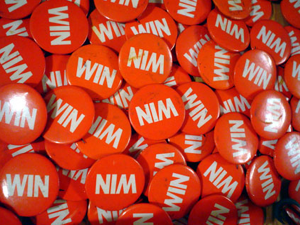
NIM is WIN upside down!I've written quite a few posts about the game of Nim, but practice is the real key.

In this post, we'll take a look at iOS Nim apps that you can download and use to practice for free on the go! Yes, there are free Nim apps for Android devices, but the variety is a little wider for iOS devices.

Most of the Nim apps you find are based on either single-pile Nim or multi-pile Nim.

For single-pile nim, try out Take Apples and NeonNim: The Subtraction Game. Multi-pile Nim can be practiced with the Stick Showdown and myQuickGame Free apps. If you want to switch between the two, there's the simply-named Nim Game and the aptly-named Appointed Win Game.

Back in June 2010, Scam School featured an episode of Nim without props. You'd wouldn't think you could turn a propless Nim game into an app, but it has been done! The calendar Nim variation is available as The Date Game. The other version is available as Race To 100.

There's also the ingenious tic-tac-toe variation of Nim known as Notakto. Notakto's winning approach isn't as easily picked up as some of the other variations of Nim. However, you can learn via my tutorials over in the Mental Gym, How to Play and Win Notakto and How To Play and Win Notakto: 3+ Boards.

There are a few variations of Nim out there, however, for which there are few (if any) ready-made tutorials. If you're up for the challenge, try a version with unfamiliar rules and strategies, and see how well you can do at working them out yourself. There's TacTix, in which you remove items from any contiguous columns OR rows, or the similar Triangular Nim, which throws diagonals into the mix, as well!

Probably the most challenging version of Nim is Hakenbush, which involves erasing lines, and eliminating any lines which are no longer connected to the base. Since there are endless possible shapes and color combinations to use, working out a general strategy is tougher than it may first appear!

I hope you find these versions of Nim fun and thought-provoking. If you have a favorite free Nim app, for any device, let me know about it in the comments!