0

New Dennis Loomis routine!

Published on Tuesday, May 31, 2005 in , , , ,

Over at Dennis Loomis' Memorized Deck Magic page, he's just posted a new routine.

This routine is Dennis' version of a classic, called "Memorized Think of a Card".

I currently perform a similar routine I call "OutSmarter". I like it because it uses the whole deck, but Dennis' routine is more direct, and will be more practical for most people.

0

15 minutes of fame

Published on Tuesday, May 31, 2005 in , , ,

Earlier today, I was checking my referral logs, and I discovered a pleasant surprise. I was the number 1 link for two different Google searches, memorized decks and invisible deck arrangement.

Google is, of course, fickle, and clicking these links won't guarantee you see my blog at the top for these search terms, but even being in the top 10 is amazing to me, especially considering that this blog is less than three months old.

0

Memory Effects Update

Published on Sunday, May 29, 2005 in , , , , , ,

I've just updated the MemoryEffects.pdf file with routines from the book, "The Mind and Magic of David Berglas" (See full contents here).

This is a wonderful book, and it is the sole reason that I haven't been updating recently (OK, there is work, too).

0

Who?!? Oh, him!

Published on Tuesday, May 24, 2005 in , ,

Earlier this month, George Bernard Dantzig passed away at the age of 90.

Even if I tell you he is a reknown statistician, you still probably wouldn't recognize the name. However, you have probably seen his story in your e-mail box:

A young college student was working hard in an upper-level math course, for fear that he would be unable to pass. On the night before the final, he studied so long that he overslept the morning of the test.

When he ran into the classroom several minutes late, he found three equations written on the blackboard. The first two went rather easily, but the third one seemed impossible. He worked frantically on it until — just ten minutes short of the deadline — he found a method that worked, and he finished the problems just as time was called.

The student turned in his test paper and left. That evening he received a phone call from his professor. "Do you realize what you did on the test today?" he shouted at the student.

"Oh, no," thought the student. I must not have gotten the problems right after all.

"You were only supposed to do the first two problems," the professor explained. "That last one was an example of an equation that mathematicians since Einstein have been trying to solve without success. I discussed it with the class before starting the test. And you just solved it!"


Snopes.com has a somewhat more accurate write-up of his moment of history.

I just thought you would enjoy this bit of odd mathematical history.

0

Our Founder

Published on Monday, May 23, 2005 in , , , , , ,

If you have spent any time, as this blog's motto says, training and straining your brain to entertain, then you've more than likely run into Martin Gardner.

Martin Gardner, besides being the author of 65 books, is best known for being the Mathematical Games column in Scientific American magazine from 1956 to 1986.

Well, for all Martin Gardner fans, and those who are curious about him, the Mathematical Association of America has just released a CD containing the 15 books that comprise all 30 years of Martin Gardner's Scientific American Columns (in PDF format)!

For those who may not be into recreational mathematics, think of it this way: Imagine your favorite musician or musical group just released a 30-year retrospective of all their music for less than $60. Well, this is a similar experience for us geeks.

0

New Link

Published on Sunday, May 22, 2005 in ,

I've noticed in my web referral logs that several people have come over here from the AllMagic.com link. Welcome! A special thanks to whoever added my link to the site, as well.

To return the favor, I've added a link back to the All Magic Guide to my "Friends" section.

0

Tour Agent

Published on Sunday, May 15, 2005 in , , , , ,

The Knight's Tour, for those not familiar with it, is a puzzle involving a standard 8 by 8 chessboard, and the chess piece known as a knight.

A chess knight can move 2 squares horizontally and 1 square vertically, or 1 square horizontally and 2 squares vertically, resulting in an L-shaped move. For example, from the position depicted below, the knight can move to any of the squares marked by an X:
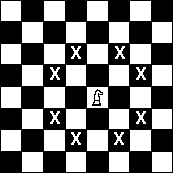


The challenge of the Knight's Tour is for the knight to "tour" the entire 8 by 8 chess board, using only its L-shaped move, and without landing on any square twice. If you would like to try this online before reading further, you can try it at Be A Genius* or Worle.com.

I myself have written about two different approaches to the Knight's Tour. I've written about a memorized approach here, and an algorithmic approach here and here.

I recently ran across a great column by Frederic Friedel, which uses the occasion of 9 year old boy performing the Knight's Tour on German TV as a jumping off point for a discussion of the classic puzzle.

Especially interesting for readers of this article will be Koltanowski's presentation, combining a giant memory feat with the Knight's Tour, and the semi-magic squares (all rows and columns, but not diagonals, add up to the same total) created using only the knight's move. Interestingly, the 150-year-old question of whether it is possible for a Knight's Tour to trace a fully magic square (with rows, columns AND diagonals adding up to the same total) was answered only recently.

The article only lists a Knight's Tour application for Windows, though. To remedy that, I created a Mac OS X version (G3, G4 or G5, running OS X 10.1 or greater required). In my OS X version, you can practice hitting all 64 squares, starting and ending on the same square, and even practice starting and ending on randomly chosen squares!

To learn about the Knight's Tour in great depth, read Knight's Tour Notes, an entire website just about the history and analysis of this fascinating puzzle.

0

Start from the beginning

Published on Saturday, May 14, 2005 in , ,

Many of you may be interested in memory technique, but may not know where to start. For those of you who fit the description, and for future reference on this site, here are some excellent free courses in basic memory techniques that can be found on the web:

Mind Tools
Memory Master
How to Develop a Super-Power Memory by Harry Lorayne
neuroMod Memory Improvement Course
Be A Genius*: Memory Basics