0

Mental Gym Moved and Site Features Updated

Published on Wednesday, July 23, 2008 in

BrainsThe Mental Gym is back up! I have relocated it to http://mentalgym.freehostia.com/. The 3-Letter Body Part Quiz proved so popular, it exceeded my ISP's bandwidth limits!

Since they deleted my access to the server which contained not just the Mental Gym, but RSS files, downloads, and other things important to this blog, I've had to make a few additional changes, as well:

• The Blog Summary feed, the Grey Matters Videos feed, the Original Products Store feed, and the Timed Quizzes Feed all have new locations, which you can now access from these links and the site feed listings at the top of the rightmost column on this blog.

• The widgets I've developed have all been updated, as well. You can find the updated versions of the widgets (where required) over in the rightmost column under Downloads. Over on Apple's widget site, you can already find the updated versions of the Grey Matters Feed widget, the How Many Xs Can You Name in Y Minutes widget, and the Date Quiz widget.

• All the Google Homepage Feed Gadgets have been updated to reflect the new feed locations, as well. If you've been using any of the Google Hompage Feed Gadgets, please update to the new versions: Grey Matters, Grey Matters Videos, Original Products, or Timed Quizzes. The Recommended Products feed gadget is still the same.

• I was unable to update the How Many Xs Can You Name in Y Minutes blog widget with the new feed, so it's down for now. If I can get it fixed, I'll post the new blog widget.

There are also other minor changes I'm making. Over the next week or so, you may see small things like broken links and missing graphics, but rest assured that I'll be working on fixing these details! Thank you for your understanding, and I apologize for the inconvenience.

0

Mental Gym Temporarily Down

Published on Wednesday, July 23, 2008 in

BrainsThe Grey Matters Mental Gym is temporarily down. It was removed due to exceeding bandwidth limits of my ISP. I believe this was due to the popularity of the 3-letter body part quiz.

This also means that some of my graphics, RSS files, and other files won't be available.

I will work on finding a new location for the site as soon as I can. I apologize for the inconvenience.

4

How To Guess Someone's Age

Published on Sunday, July 20, 2008 in , , ,

Birthday Cake(Update - May 3, 2012: This post has been updated, revised and clarified as a series of posts. The new age-guessing posts can be found at these links: Part 1, Part 2, Part 3, Part 4)

For as long as carnivals have been around, and probably much longer than that, there have been people who have tried to guess another person's age. Age is often not talked about openly, so how would you even begin to go about it?

The first thing that comes to mind for me, naturally, is the mathematical approach. First, there's what I call the algebraic approach to finding someone's age. You have them perform a series of calculations that include their age, and the answer will, in one way or another, secretly tell you how old they are. The most common tricks of this type you'll probably run across is the choose your age and a secret number version, or one of these two approaches. The precise answer that results is great. However, anyone who is familiar with algebra can work out why these work. Even those links themselves point out that the best use for those kinds of tricks is for generating interest in a math lesson.

To add at least some mystery, you could turn to what has become known in magic as the Age Cards. As a matter of fact, you can try a Javascript version of the Age Cards here, and a Java version with a link to the explanation here. Personally, the best way I've come across to present this ancient effect is Werner Miller's Age Cube (as long as you're sure the person isn't 32 or older), as the arrangement of numbers are given a different purpose than just "random numbers". This helps hide the method more effectively.

These mathematical methods are nice, but what about judging their age the classic way, by their appearance and lifestyle clues? Over at the Vat19.com blog, they've posted a very comprehensive guide to accurately guessing someone's age. Of course, having the information is one thing. How do you practice using that information?

Strangely enough, age guessing has caught on as an internet meme. There are many sites with a seemingly endless supply of pictures of real people whose age you can guess. Among the more popular of these sites are AgeGuess, The Age Project, Match>Age, and Guess My Age. The best thing about these sites is that you'll find the more practice you put in with these sites, the more accurate you can get.

However, even if you were to practice every moment you were awake, there's still no way to get a perfect guess every time. Even those carnival workers who guess your age say they'll guess it within a margin of error, such as 2-3 years. The purely mathematical approach offers precision, but can be easy to figure out, thus diminishing the impact of a correct guess. Perhaps there's a happy medium?

Using both approaches together can actually be very effective. Adding mathematics to the appearance/lifestyle approach adds precision, while adding the appearance/lifestyle approach to the math helps take the heat off of the math. One simple way to combine them is to hand a calculator to someone, and ask them to enter any 4-, 5-, 6-, or 7-digit number into the calculator, without telling you what that number is (For example, let's say they enter 32,419). Next, have them multiply that number by 9 (in our example, that results in the number 291,771), and then add their age to that total (Let's say they're 33, so they add 291,771 to 33 to get 291,804). Once they tell you the final total, you can give their correct age!

How is this possible? What you do is mentally add up the digits in the final total (In our 291,804 example, you would mentally add 2+9+1+8+0+4, to get 24). Use this number as a starting point (24, in our example), ask yourself whether this person appears to be that age, and if not, whether they appear older or younger than this number. If the person seems younger than the number you get, subtract 9, and ask yourself if the age seems right again. If the person seems older than the number you get, add 9, and yourself if this seems right again. In our example that results in 24, you would probably look at the guy, and determine that he's older than 24, so you would add 9 to get 33. You look at him, and that seems right, especially as adding another 9 would result in 42, and he appears far too young to be 42. With this result in mind, you state that he's 33! As long as you've practiced with the age guessing sites I mentioned earlier to the point where you can get the correct age within 2 or 3 years, this should pose little problem.

If you're wondering why this works, it's all due to the digital root of the numbers involved. When you multiply any number times 9, you're insuring that you now have some number whose digital root is 9. When the age is added, the result will be a number with the same digital root as the person's age (thanks to the 9 principle). Since any two numbers whose difference is a multiple of 9 will have the same digital root, you can keep adding or subtracting 9 to the result you get until the age seems right. Anyone trying to work this out solely with algebra will realize that all you had to work with was 9x + a (x being the random number, a being the age), and it won't make much sense to them.

Probably the most deceptive version of mathematically determining someone's age involves only days and dates, so it seems like no math could be involved. For this version, you ask someone whether they've already had their birthday, and when it will be (or was) this year. Handing them a perpetual calendar, you ask them to look up the day of the week on which they were born. You ask them not to state the year, but rather just state the day of the week on which they were born. After this, you study their lifestyle and appearance clues, and announce exactly how old they are (or, alternatively, the year they were born)!

As an example, let's say someone tells you their birthday this year was on June 14th. After looking in the perpetual calendar, they tell you that they were born on a Monday. You study the person, and announce (correctly) that they're 43! Are you curious as to how this is possible?

Before you even think of performing this version, you need to be very comfortable performing the classic version of the Day of the Week for any Date feat. You'll also need to have the year keys memorized, as described in this article, in section 3.2.5: Memorizing the Key Numbers. Once you can do that, you'll fully prepared.

Always ask for their birthday in the current year, so that they don't slip and accidentally give you the year they were born. When you're given the month and day, add the month key and day. If you're given June 14th, as in our example, you would add 4 (the key number for June) to 14 (the day) to get 18. Next, when give the day of the week, convert that day of the week to it's key number, and immediately add 42. In our example, the day is Monday, you convert that to 1, and add 42 for a total of 43.

Next, we're going to subtract the month and day total from the adjusted weekday total, and cast out 7's to get a number from 0 to 6. Keeping with our example, we'd perform 43 (adjusted weekday number) minus 18 (the month and day total) to get 25. Casting out 7's (or figuring modulus 7, as math majors would call it) from 25, we get 4 (21 is the largest multiple of 7 under 25, so we do 25-21 to get 4). This single-digit number (4, in our example) will be used as a year key.

Math break: Why did we add 42? As you have learned (or will learn) from the classic date feat, adding or subtracting 7's doesn't substantially change the number (no more than adding or subtracting 7 days from now will change the day of the week), so we need a multiple of 7 for the day adjustment. The largest month key we'll be using is 6, and the largest day we can get is 31, so the largest month and day number we can get is 37 (6+31). From what multiple of 7 can we subtract numbers up to 37, and still get a positive answer? 42 is the answer (Any larger multiple of 7 could also be used, but 42 keeps it minimal).

Once you've figured the year key, you need to look at the person themselves (actually, you've probably been doing this all along). In what age range would you place them? To move our example along, let's say you think the person might be in their late 30s or early 40s. We need to find a year in the age range you've determined whose key number is the same as the year key number you've determined. Turning back to our example, is there a year roughly 40 years ago whose key number is 4?

First, try 40 years ago itself. That's 1968, whose key number is 1. OK, it's not 1968. How about later? 1969 is 2, 1970 is 3, and 1971 is 4! Does 37 work? Look at the person and ask yourself if 37 seems too young. Trying going back from 40 years ago, too. 1967 has a key of 6, 1966 is 5, and 1965 is 4! Hmm, they could also be 43. You can begin to see now why you both need to memorize the year keys, and why you need so much practice determining someone's age. In our example, you would have to ask yourself whether 43 or 37 seems more likely.

With this version, there are a few things you'd have to remember. First, if they're born in January or February, you'll want to add 1 to your key number when checking leap years. If someone who looks to be around 40 tells you they were born on January 12th (0+12=12) on a Friday (5+42=47), you'll get a key of 0 (47-12=35, 35 mod 7=0). Since 1968's key is 1, and your key is 0, you might think that 1968 won't work. However, if you temporarily add 1 to your key number when checking 1968, you'll realize that 1968 is a possibility (By the way, January 12th, 1968 did fall on a Friday). A similar principle applies when working with other centuries, except you'll need to add 0, 2, 4, or 6 to your key number (and not temporarily, as with leap years).

If you're trying to determine a woman's age, and you find two close possibilities (like our 37 and 43 examples above), always, Always, ALWAYS, ALWAYS give the younger of the two possibilities. She'll take it as a compliment, and will never correct you.

It should go without saying, that when performing any of these versions, you should warn someone that their age could possibly be revealed. If they don't approve, move on to something else!

2

Review: Mind Blasters

Published on Thursday, July 17, 2008 in , , , , ,

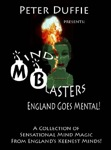
Mind Blasters, by Peter DuffiePeter Duffie has been publishing a series of magic books gathering great material from English and Scottish magicians. This series includes England Up Close, Scotland Up Close, and Miraculous Minds (Scottish Mentalism). The newest entry in this series is Mind Blasters, which features mentalism routines from British magicians.

This book contains an amazing number of contributors, so instead of giving a full review for each and every effect, I'm going to focus on the routines that will interest regular Grey Matters readers.

The whole reason the book caught my attention in the first place was due to two things, the name Harold Cataquet, and the words Knight's Tour next to his name. In this version, you start the Knight's Tour from a chosen square, and have the spectator number the squares as you go (The first square is marked 1, the next is marked 2, and so on). Not only are you able to complete the Knight's Tour, but show that your path has resulted in a semimagic square! (Note: Unfortunately, a fully magic square resulting from a Knight's Tour is mathematically impossible.)

The work and analysis that went into this is just incredible. Not only is there a process for doing the Knight's Tour as described above, but there is a new mnemonic approach developed to aid this method. The one downside I see to this approach is that, in some cases, chess players will immediately know that something isn't quite right, so you risk losing their interest. How much of a concern this becomes is really up to your persona and your audiences. This write-up is definitely a new step forward in the Knight's Tour, and should be part of any research you do towards performing it. I should mention that I'm not just giving this a good review just because a link to my Knight's Tour in included in this routine (but that didn't hurt, either).

Shiv Duggal's Frequency is another routine of potential interest to my readers. This is a three-phase pseudo-memory routine with playing cards. After the deck is shuffled by a spectator, they look at a random card in the deck. After that, the performer memorizing the order of the deck, and is able to give the position of the selected card after it's named. In the 2nd phase, the performer memorizes half of the deck, has a card selected from it, placed in the other half, and using memory is able to find it. In the final phase, three cards are removed from the deck, and the performers looks at each of the remaining 49 cards, then recalls which cards weren't seen. Frequency isn't for budding magicians or mentalists, but if you can manage the skills required, this is a powerful routine for those who want to look like a memory expert using a legitimately shuffled deck.

1812, by Stephen Jones is a great way to predict the multi-digit outcome of an addition problem created at random by your audience members. The basic principle itself isn't new (it can be found in Secrets of Mental Math, Predict Perfect, and elsewhere), but I like Stephen Jones' handling of it. He also provides one of the clearest explanations I've seen of the principle, so you can customize the routine to your particular needs. Quick Tip: You can use the 1812 handling to significantly reduce the work required (From remembering 198 links, down to 6!) to perform my Psuedo-Phone Book Memorization feat.

Wayne Dobson's Fluke and Stephen Tucker's ACAARN are almost directly opposite tricks. They both take a step back from the pure Any Card At Any Number routine, where the spectator freely selects both the card and number, but still manage to become impressive effects on their own. In ACAARN, the performer writes down a location before a card is fully named by the spectators. You take the cards out of the case, count to the position, and the named card is at that position. In the case of Fluke, the magician brings out one deck containing a prediction, and another for the spectator to use. The spectator names any position from 1-52, and the magician/mentalist shows his prediction. When the spectator counts to their selected position, the predicted card is found at that location. This latter version does employ a gimmick that could be exposed, but it won't be hard for any regular reader of my blog to figure out how to eliminate the gimmick. Between the two, my personal preference is for Fluke, but the methods for either one are worth investigating, and both can inspire some ingenious variations.

There are a number of other routines which feature methods that you'll find intriguing if you enjoy this blog. Stephen Tucker's other routine, 58 to 1, is a divination of the name of an imaginary place chosen by the spectator. The technical demands are minimal, and there's nothing written down. However, from a presentational standpoint, the method can be obvious if not performed correctly. If you're seriously interested in doing this routine for a paying audience, I would recommend learning important presentational details about this type of method from Doug Dyment's Sign Language first.

If you liked the works of Leo Boudreau, check out Remote Viewing Magic. Les Johnson takes Boudreau's work in a new direction by using it to divine a chosen scene. Even as clean as 58 to 1 is, this is even cleaner and more direct.

In Roger Curzon's Devil Rides Out, a spectator chooses from several random numbers from a grid, above which is the picture of a devil. After the spectator adds up their chosen numbers, the devil disappears, simultaneously bringing a prediction into view. Even though some may consider the two ideas here to be old and uninteresting, I like the fact that they're used here to create a piece of mentalism that features a rare visual climax.

The final routine I'll mention here is Two-Person Book Test by Mike Hopley. If you perform mentalism with a partner, here's a routine that will be unfathomable to your audiences. The “sender” takes any borrowed book, and rapidly highlights several words from the first line of different pages using a pencil, all while saying absolutely nothing. The spectator takes the book back, and freely chooses any page with highlighted words. After the line is read to he “medium,” he or she is able to divine which of the words are highlighted. This can be repeated several times without the sender saying anything, or even needing to be in the same room! For a climax, the medium asks the person to concentrate on the last digit of a selected page number, and the medium is able to divine this, as well.

The method of communication will be very familiar to the readers of this blog, but is well hidden by the routining here. Even members of your audience who are familiar with the principle at use here will not recognize its use. While many routines like this must be constantly studied with a partner, this one is simple enough that, once you're assured that each of you has the basics down, you can decide to do on the fly. If you can convince your audience that you're not working together, the trick will come across as even more powerful.

As you can see from the list of routines, I haven't even mentioned a full quarter of what is in this book. Whether you're into mentalism, or even if you just want to research incredible new ways to use some classic ideas, I think you'll find that this book is a great value, especially considering the low price you're paying for the knowledge of so many prominent mentalists. Every year there is one book that stands out head and shoulders above the rest, and I believe Peter Duffie's Mind Blasters will be that book for 2008.

0

Great Moments in Memory and Mental Math

Published on Sunday, July 13, 2008 in , , , , ,

BrainEvery so often, I run across great stories of geniuses who show exceptional mental prowess, often while still young. I'm going to share some of my favorites.

The first is probably the most famous, featuring a young Carl Friedrich Gauss. It may or may not be true, but I'll pass it on anyway. Gauss' teacher needed to occupy the students with busy work (some versions of the story say it was to talk to other faculty members, others say it was to take a nap), so he assigned the students to add up all the numbers from 1 to 100. Young Gauss was able to produce the correct answer, 5050, in just a few seconds, and without writing anything down!

How was that possible? Gauss took a look at the problem first, and was able to find a pattern that made the problem far simpler. His aha! moment came when he realized 1+100=101, as did 2+99, 3+98, and so on, all the way up to 50+51! Thus the problem became a matter of multiplying 50 by 101, which is much easier and quicker to do mentally. The bloggers at Better Explained can not only help you better understand how problems like this are solved, but also help you realize that one problem doesn't mean only one approach.

This next story is far more recent, and concerns Arthur Benjamin, whom many of you probably know from his TED video. In his book Secrets of Mental Math, Dr. Benjamin tells of a time when he was only 13, his teacher demonstrated how to work out a problem, and concluded with an answer of 1082. Apparently unhappy with what he saw as an unfinished problem, he blurted out that 1082 was simply 11,664!

The teacher was amazed that a 13-year-old could square a number like 108 in his head. The method he used, detailed in the above book, was roughly the same as this squaring method described on MathPath. When he explained his approach, and the teacher commented that she'd never run across this method, thoughts of being famous for this new discovery ran through his mind! Unfortunately, when he ran across the very same method in Martin Gardner's Mathematical Carnival, he realized this was not to be. I suggest reading the full story in Secrets of Mental Math, not only for the method, but also to learn how he discovered it on his own.

Dr. Solomon Golomb, who is a respected mathematician, engineer, and puzzle expert, had his own great moment in his college freshman biology class. The teacher was explaining that human DNA has 24 chromosomes (as was believed at the time), so the number of possible cells was 224. The instructor jokingly added that everyone in the class knew what number that was. Golomb immediately responded that it was 16,777,216. When the instructor didn't believe the number was right, and looked through his noted to find the correct number, he was stunned to find that Golomb was exactly right! Not surprisingly, Golomb instantly the nickname, “Einstein” from his fellow students.

But how did he know the answer? As it happened, Golomb had memorized the answers to all the exponential expressions from 11 up to 1010 as a personal challenge. While he hadn't didn't know the answer to 224 itself, he did realize that it was the same as 88, which he did know!

Learning the answers for exponential expressions up to 1010 is akin to learning the multiplication tables, but since the results go up into the billions, it seems much more impressive. You can learn to do this yourself in the brand new Exponential Expressions section of Grey Matters' Mental Gym.

Dr. Golomb's ability to stun his college instructor using memorized information reminds me of one of my own college experiences. In my case, I stunned my art history teacher with my ability to perfectly recall the names of 60 paintings, their respective artists, and the exact year each one was painted. Was I instantly regarded as an art genius? No, I was accused of cheating (click that link for the full story).

I'll wrap this post up with a story of memory skill that happened back in Ancient Greece in the 5th or 6th century BC, yet still resonates to this day. Simonides of Ceos, a respected Greek poet, was attending a well-attended banquet dinner. Like all orators of the time, Simonides possessed a great memory as a tool of his trade. After giving his speech toasting the guest of honor, Simonides went outside for a break. While he was there, the roof of the structure collapsed, killing everyone who was inside. As the excavation happened, city officials called for Simonides' help to identify the bodies.

Incredibly, Simonides was able to identify every body from the banquet dinner! He later realized that he was able to do this because he knew the people by where they were sitting. It was this experience that inspired him to create a formal memory system based on locations. This system is still used today, and is known as the Journey System. It involves visualizing something that represents the first point of your presentation in the first location of some familiar place (say, the bedroom where you wake up). To recall your second point, you mentally travel to the second point in your journey (say, the hall outside your bedroom), and see a different image there. In this way, it's possible to remember hundreds of different points without any notes.

The memory system itself isn't all that survives to this day. As orators throughout the ages used this same technique, it wasn't uncommon for them to refer to the journey through their mental structures as the speech was given. This tradition of references to mental journey stayed around long enough that it eventually came into the English language as, “In the first place . . . ,” “In the second place . . . ,” and so on.

1

iFlipr

Published on Thursday, July 10, 2008 in , ,

iFliprI've been wondering when flashcards would meet the iPhone. I now wonder no longer.

The two have met at long last, thanks to iFlipr. It's a free flashcard site that, while specifically designed for the iPhone, will work on a regular computer, and even most older phones with internet access. Like many of the better flashcard programs and sites I've discussed, it employs the Leitner System, so that you're quizzed more frequently on items with which you have more trouble.

Rather than a long description of the features, check out their introductory video:


I like that it can be used on my desktop, but for portability I may just have to pick up an iPhone after all. Although, I'm probably not going to even get near an Apple Store tomorrow.

0

Character: Definition

Published on Sunday, July 06, 2008 in ,

CharacterOnce you've decided to pursue a performing character, you're faced with the even bigger question of where to begin.

The traditional advice is to “be yourself.” As far as preventing performers from copying each other, that's great advice, but beyond that, the advice is far too simplified.

The best place to start is by examining where you are presently. What types of routines do you like to perform? Look at those routines from your audience's point of view, and ask yourself what those routines suggest about the person performing them. As a group, do they suggest their performer is funny? Intelligent? Psychic? Suave? Creative? Quick-Thinking? As you do this, you'll probably find that some conflicting messages are being sent by your routines. If you have to be the funny man at one point, then the deep-thinking man of mystery shortly afterwards, you'll have to make a decision about which direction you really want to take.

It's very important to remember that your character is not you. It can range anywhere from a minor extension of you (such as Ricky Jay's scholarly persona), or it may be a complete caricature (such as Rudy Coby's otherworldly scientist persona). In Richard Tenace's article, The Base Character, he brings up some excellent basic questions that you should know about your character. The more detail you know about your character, the better.

As a matter of fact, questions are a great way to develop your character. You'll note from my Questions For Better Magic, especially the questions on character, that I'm a big supporter of asking better questions to get better answers. John B. Pyka, who usually charges much more to consult on theatrical character development, has generously shared some excellent character development questions at no charge! I find the killer/victim/witness question especially interesting, as that one single question will do more to bring focus to your act than any other I've seen.

Screenwriting resources, such as iFV's Character Questionnaire , can also provide some very thorough food for thought. I've previously mentioned Dramatica and Story Fanatic as great resources, too. While Dramatica does focus on larger, more fully developed stories, I've found their 12 essential questions a very useful tool. Story Fanatic's Thinking of Your Audience First post is very helpful in figuring out what effect the various decisions can have on your audience.

One fun way to develop your character is to put him or her through those internet personality tests you see so frequently. Regardless of their true psychological value, the test results can often prove valuable as inspiration. If such a quiz describes your character as having a trait which you think would make them less effective, you're free to discard it! Two of my favorite quizzes for this purpose are PersonalDNA, because of the rich descriptions in the results, and the Jung/Meyers-Briggs Personality tests (also known as the Meyer-Briggs Typology Index, or MBTI), due to the large amount of online resources that can help take a better look at your results. Once you know your MBTI type, you can do more research at sites like TypeLogic, Socionics, and Dave Nevins can provide plenty of detail to inspire you. One interesting source of inspiration is to look at other fictional characters with the same MBTI type as yours.

Keep in mind that creating a character is not a one-time event. Rudy Coby once noted that the secret to an effective performing character, once you began the process, was summed up in two ideas, developing your character, and getting as much time in front of an audience as possible to constantly determine the effectiveness of the character in order to refine it. This is one of those journeys where the journey itself is the treasure you seek.

0

Character: Purpose

Published on Thursday, July 03, 2008 in ,

CharacterI talk quite a bit about performing memory feats, lightning calculations and magic, but I don't get to talk much about what performing really means. The most essential thing to performing is a character. But why it is so essential?

The short, dry answer can be found in section 2A of my questions developed from Strong Magic. Developing a character puts the focus on you, as opposed to the tricks, creates certain expectations, and makes it easier for the audience to care about you as a performer.

A more vivid explanation, which is worth hunting down, is Jon Armstrong's essay, Superhero Theory, as published in the December 2004 issue of Genii Magazine. In that essay, Jon uses superheroes as a good example of how to develop a magic character, as they both have extraordinary powers and need to be memorable in the public eye. Jon's main points in this work are:

• Superheroes are defined by their powers, to the extent that they're often named after them (e.g., Spiderman, the Flash).
• Audiences are familiar with what a particular superhero is capable of, so the heroes have certain expectations (without being made predictable), and they're made more memorable.
• Superheroes are limited by their powers (e.g., Batman doesn't have X-ray vision, Spiderman can't talk to sea creatures), creating focus, as well as opportunities for challenge.
• Speaking of limitations, many superheroes also have a weakness. How they deal with this weakness can be as engaging as how they use their superpowers.


In every successful superhero comic book, graphic novel, and movie, you'll find that these basic principles are employed repeatedly throughout. Do your audiences ever develop expectations, and get such a clear idea of who you are? Perhaps it's worth asking yourself if your act is up the standard of your favorite superhero.

If you perform close-up magic, you might think that this extra work is only needed for stage performers. As Richard Tenace will tell you, a close-up kind of actor is needed even more than on stage! Close-up workers have smaller props to hide behind, so a more defined character is even more essential.

Contrasted with what can happen due to a lack of character, you'll find that the work required to develop a character will reward you many times over in the response you get from your audiences and your clients.

If you're sold on developing your performing character, the next question is how to go about it. That will be the topic of my next post.