0

Mental Ladders

Published on Sunday, January 20, 2008 in , ,

Prove Your LogicWhat, you may very well ask, is a mental ladder? Just as with a physical ladder, you proceed from one step to next until you get to the top. If you get stuck on a particular step, you either stay on that step or move back down. In the case of mental ladders, however, the steps are puzzles to be figured out.

I mentioned a math-based mental ladder last month, called The Brain Tower, in which you figure out the answer, and use that to create a URL that, if correct, takes you to the next puzzle.

If you prefer logic puzzles, then you should definitely try Prove Your Logic. This Flash-based game has 25 levels of logic problems. Some of them are classics, yet many were completely new to me. I like the way this one is woven as a story, and is one of the few that occasionally give you more than one chance to answer.

Mental ladders can get very creative. In the Brain Drain Game (Flash), you're presented with a screen, and minimal hints. From there, you have to figure out not only how to solve that level, but what the object of the level is in the first place!

Another creative approach is Hacking, which is a mental ladder done as a hacker simulation. Instead of just being played in your browser, your browser itself is one of the tools used to solve each level. You'll want to make sure your HTML, javascript, graphics, php and logical thinking skills are up to par to get through this one!

Qwyzzle is a 100-step mental ladder! If your browser has a status bar, make sure it is on (usually found in the "View" menu, depending on your particular browser), as you'll occasionally need the hints presented in it. The answers to the puzzles are of the general knowledge variety, so the more familiar you are with various celebrities, phrases, trivia and so on, the better you'll tend to do.

Enjoy these ladders, and I hope to see you at the top!

0

Still More Quick Snippets

Published on Thursday, January 17, 2008 in , , , , , ,

LinksOK, class. It's time to sit down in your seats, and look forward to today's links:

* Our first subject is 20th century history. Your assignment is to study Billy Joel's We Didn't Start The Fire. Have you studied? Good, then it's time for your history quiz! If you didn't do as well as you hoped, I suggest reviewing notes on the video. Alternatively, you could just move on to the history of 2007, courtesy of JibJab.

* The next subject is physics. We'll start simply with xavierenigma's game Next Physics, which is a little like a sandbox for physics. Just sketch any shape anywhere, especially trying to create levers and the like, and see the effects of physics on your sketches! Ready for more advances physics? Good, because you'll need to compensate for gravitational pull in Gravity Pods. Aim, shoot, and try and work your way around obstacles with the effects of gravity!

* It's time to move on to foreign language class. First, review the basics of learning a new language, which I discussed last April. If you learn best on your own, try learning a new language via podcasts. If you instead learn better with the help of others, you might prefer one of the social networking language sites, such as babbel, livemocha, mango or myngle! You can review on many of the sites, but there's also the flashcard programs I mentioned here, here and here.

* Let's wrap this up with some lessons in logic. Those of you who enjoyed my recent article on Mastermind will be interested in a different approach to the game, taught interactively by Alex Bogomolny and Don Greenwell. Connoisseurs of classic puzzles will enjoy Mental Floss' article on Rubik's Cube variations, and Mathematrix's articles on that and other classics. In Building Houses, you have to construct a structure given 3 flat views and a limited number of blocks. For Mac OS X users, there's also a free offline version called POV.

I see by the clock on the wall that class is coming to an end. Those of you who still want to stay in and explore can check out some of the toys around the room, such as the coin jar calculator and the marble adding machine:

1

Genius on TV

Published on Sunday, January 13, 2008 in , , , , ,

Numb3rsCertainly, you can learn enough feats from this site and its links to present yourself as a genius. Just how are geniuses presented, anyway? I thought it might be fun to look back at how TV has presented their genius characters.

To help you understand these types, many of the links below have links to one or more free full online episodes of their respective shows, which I've marked with (fe) next to their names.

* Professor: This is the classic genius caricature. Whenever the Professor is faced with a problem, his intellect is able to devise an ingenious way to solve the problem. Note that the Professor type is usually portrayed with minor emotional qualities, and is a neutral character who often helps settle disputes. As long the other characters around them understand these quirks, they get along fine with others.This category is named after the Professor from Gilligan's Island (fe), but would also include Star Trek's Mr. Spock, CSI's Gil Grissom (fe), Charlie Eppes of Numb3rs (fe), and MacGyver.

* TV Genius: The TV Genius would be the Professor type taken to extremes. Instead of simply having minor emotional qualities, they are presented as the quiet, maladjusted type. Interacting with other people is very difficult to them, even to the point of being baffling, but dealing with numerous analytical details is simple and fascinating for them, as if they were borderline autistic. They're often impossibly smart to the point that they can handle all branches of science with equal brilliance. Austin James in Probe (fe), Back To The Future's Doc Brown, and most of the cast of Frasier would fit here.

* Teen Genius: Unlike the previous types who tend to have some difficulties in dealing with people, the Teen Genius has fewer odd quirks, except for the natural problems that come with being a teenager. While Doogie Howser, M.D. (fe) is probably the first example to come to mind, there is also the four main characters of Whiz Kids (fe), Growing Pains' Carol Seaver (fe), and Willow on Buffy, The Vampire Slayer (fe).

* Insufferable Genius: This type frequently boasts of their amazing knowledge, and seems to come across as a know-it-all at first. Then, the other characters learn that this character really is as good as he says, but usually continue to regret the boasting. Many of you are probably already thinking of House (fe), but M*A*S*H's Winchester and Hercule Poirot are also classic examples of this.

* Genius Ditz: Reconciling opposites often makes for interesting characters, and applying that to geniuses gives us the Genius Ditz. These are often characters who have been originally presented as not being too bright, but are actually brilliant in one particular field. Deep Space Nine's Rom had a great talent for engineering. This type of genius is often used in kid's shows, such as the Electric Company's Fargo North, Decoder (fe).

* Genius Bruiser: The Genius Bruiser is another attempt to get away from the standard genius stereotype. When first introduced, they're thought of as a bully or a muscular brute. Later, it's discovered that they also have a brainy side, usually manifesting as some specialized geeky ability or interest. The X-Men's Dr. Henry "Beast" McCoy, and, surprisingly, B.A. Baracus of the A-Team (fe), who was occasionally shown repairing and developing electronic gadgets, are classic examples.

These, of course, aren't the only ways geniuses are portrayed on TV, only the most frequently used. Thankfully, newer approaches are being developed, too. For example, Psych (fe), features a character, Shawn Spencer, who is skilled at observation and deduction, but the police originally think this knowledge is so good, he must've been part of the crime. To keep from being prosecuted, Shawn has to keep up a facade of being psychic.

One of the best shows on TV for comparing approaches to smart characters would have to be Head of the Class (fe). This show focuses on a group of advanced placement New York high school students, and their teacher's unusual approach to education. With so many smart characters in one place, it's often interesting to see how they made the characters so different from each other, as well as the kind of challenges they faced.

Do you have any favorite geniuses from TV? I'd love to hear who it is and what you liked about their approach in the comments!

0

Election Time

Published on Thursday, January 10, 2008 in , , , , , , ,

Vote Smart buttonIf you've seen anything of the news from the US, you can't miss that an election year has started. With so many people talking about it, the US elections can be a great theme for demonstrations.
The simplest approach to adopting this as a theme is to adapt routines you already do. If you do demonstrations with playing cards, imagine the possibilities with 2008 election-themed cards, in Republican, Democrat and Independent versions!

Another approach is to work up a demonstration that has a natural tie-in to the election. Memorizing all the US Presidents is a natural approach, which many have done with the help of the Animaniacs (made in 1995, so it stops at Bill Clinton):


If you've practiced the Peg/Major System, you can go above and beyond just being able to name them in order. Imagine being able to name the years in which each president took office! Of course, learning the US states and capitals can be tied in easily , as well. Once you get them down, you can make sure they stay in your mind by quizzing yourself regularly.

Math principles can also make for some fun and amazing election demonstrations. What's known in magic as the Miraskill Principle is a powerful mathematical concept. If you use the variation from the Point Spread routine in Simon Aronson's book Simply Simon, it's easier to see how it can be adapted to an election theme. As a matter of fact, Paul Flory and Gary Ouellet have done just that in their Election Night routine. The mathematical principle behind these two routines is front and center in the routine, but it so counterintuitive that the result is baffling.

Another counterintuitive mathematical principle that's been adapted to an election presentation is that of nontransitivity. While it's most commonly associated with dice, Rock/Paper/Scissors, and Penny's Game, it can also be adapted for use with an election theme. Robert Neale published his routine, Election Game, in the February 1973 issue of Pallbearers Review. It can be done as a psychic routine, but I've adapted it for use as an apparent memory and logic demonstration, too.

Despite the dreariness that's usually associated with elections, I hope I've given you the idea that there is also fun to be had with them.

0

Fun Calendars

Published on Sunday, January 06, 2008 in , , , , , , ,

Human CalendarNow that you know some fun feats with calendars, how about taking some fun approaches to calendars themselves?

The human calendar, as you can see to your left, is a unique online calendar. It features pictures of people holding cards with various information, such as the date, month and day of the week. The current date is the only one where the person is looking forward. That person is very easy to spot, since every other person in the calendar is looking towards them. While I like the full version on their front page, they also have options for adding a smaller version to your website, blog or social network page, and it's as easy as posting your favorite video!

Of course, I can never spend more than a few paragraphs away from anything dealing with math or memory, so I'll now turn to Werner Randelshofer's Rubik's Cube page. What does this have to do with calendars? Go to the Virtual Cube page, scroll down the Virtual Cube menu, and select Calendar Cubes. When you do that, a menu of languages will appear below. Select your preferred language, and a virtual Rubik's Calendar Cube will appear. Instead of trying to solve the entire cube, as you normally would, the idea of a calendar cube is just to get the current day month and date on one face, perfect for people who can only solve one side of the cube anyway.

Would you prefer to try a calendar cube in real life? While they don't sell them ready-made, it is possible to make one. First, you need the pattern for the cube design, which is provided at the bottom of the text next to each virtual calendar cube. You'll also need a blank Rubik's Cube, and some customizable sticker sheets. Print out the designs from the calendar cube page on the sheets, and apply them to the blank cube, and you're set to go!

About 2 years ago, I mentioned the idea of having yourself blindfolded, with a calendar cube in hand. Someone gives you a date, including the year, and you solve one face of the cube to show the proper date, including the day of the week! You know the day of the week for the date before you even start working the cube, of course. As long as you have a perpetual calendar so that they can verify the date, you could turn this into quite a feat!

How about some different approaches to real-world calendars? At Marlie's Creative Universe, she includes a wide variety of calendars that you can make. There are simple paper calendars for a table or your computer monitor, and even calendars made from more unusual materials, like 3.5" floppy disks or CD cases.

My favorite of all of them, however, would have to be Marlie's designs for dodecahedron calendar. What better use for a 12-sided object than a calendar? She includes designs for 2008, but it is possible to make this calendar for any year you want. As Marlie mentions, she was originally inspired by Ole Arntzen's 12-Sided Calendar page. This page will generate a PDF or Postscript file for you in many languages, and almost any year. If you don't care for all the cutting and gluing that the dodecahedron requires, you can also make it in the form of a rhombic dodecahedron, which is made only by folding!

Speaking of generating calendars online, there are numerous sites where you can create customizable calendars, and download them as PDFs. Two of the best I've found are the Somacon Calendar Generator and PDFCalendar.com. Both of these give you more control over the design of the calendar than most other online calendar generators that I've seen.

Given all these unusual shapes and materials, you might think the simple business card calendar, such as you might get for free from your bank, can't offer much in the way of novelty or originality. However, you would be wrong. A Mexican blogger by the name of Eliazar Cardenas noticed that his mother was having trouble reading those small business card year calendars. His solution? Host an infodesign challenge to find better ways to fit an entire year on a business card. Just keep scrolling down to see the amazing variety of ideas and designs that resulted! If you enjoyed design #16, you can find out more about it at thumbcalendar.com.

That's all for now. I'll post again on Thursday, the . . . uh . . . darn. Does anybody have a calendar handy?

1

Mental Math Tricks

Published on Thursday, January 03, 2008 in , , , ,

calculatorFirst, a quick thank you to Rick Carruth and his Magic Roadshow newsletter for prominently mentioning Grey Matters in their recent newsletter! As Rick suggests, explore the site! The tabs at the top and the rightmost column, both featured on almost every page, are the best places to start exploring it.

One way to set yourself apart, whether in performance or in real life, is to be able to do math quickly in your head. While I've posted on this topic numerous times before, the increasing popularity of mental math methods has lead me to post an update.

Over at the list universe, one post that has copied on numerous blogs is 10 Easy Arithmetic Tricks (Hat tip to lifehacker for helping me locate the original). Here, you can learn how to quickly square certain numbers, multiply, subtract and even work wither percentages! I'm linking to the original, as opposed to simply re-posting it, because there are more hidden gems of mental math in the comments that follow.

If you're looking for shortcuts that are a little more useful in daily life, Mental Math Shortcuts show you quick tricks for time, distance, money and general tricks that come in handy. The BetterExplained blog, as a matter of fact, has a great series of math posts. This blog is also the source of the impressive Instacalc calculator that I first mentioned and embedded in my Geek Logik post.

If those first two posts have whetted your appetite for mental math, how about complete courses in mental math? Mental Math Master offers a complete set of free tutorials, many of which include practice exercises, that cover all the math basics.

The most extensive list of shortcuts for particular situations that you're ever likely to see, though, is BEATCALC ("Beat The Calculator"). BEATCALC is constantly expanding, and currently features 600 shortcuts! This site works best as a compliment to other courses, such as Mental Math Master. Once you understand basic approaches to mental math and have an idea of why they work, the shortcuts on BEATCALC become easy to understand, and you can even start developing your own!

Naturally, you can find plenty of information about mental math here on Grey Matters. Look through the math category of this blog and the technique category of the video blog, as well as the Mental Gym for starters. The Grey Matters store features many books on math and mathemagic that are helpful, too.

The real key to success of mental math is practice! Besides the workout section of the Mental Gym, you can also test your skills at the University of Saskatchewan's mental math drills.

Even if you don't learn all the approaches, just getting a few of the skills mastered can be a big boost to your education and self-esteem. Explore these pages and have fun!

0

Calendar Fun

Published on Sunday, December 30, 2007 in , , , , , , , ,

Day For Any Date CalendarSince we're about to switch over to a new calendar, how about some new calendar fun to go with it?

As many of you know, you can learn to give the day of the week for any date, and even practice the feat, right here on Grey Matters. If you want to make the work easier, there's my specially-prepared Day For Any Date Routine 2008 calendar, too.

The fact that calendars always have numbers in order and increase by 7 from week to week makes makes many mathematical tricks possible. A simple example would be having someone circle any 3 days in a row. Once they've done that, tell them to add up the 3 numbers they circled, and to give you the total. When you get the total, simply divide it by 3, and that will tell you the middle date. The other two dates, of course, are the ones immediately before and after it. If they gave you a total of 48, you divide it by 3 to get 16. This tells you that they chose the dates 15, 16 and 17. This will also work with columns, too, but you'll have to add an subtract 7 for the remaining two days. If they give you 57, you divide it by 3 and get 19, which tells you that they chose 12, 19 and 26!

What about other arrangements of numbers? Here's an article that starts by teaching you a simple calendar feat with a square group of numbers, and proceeds to show you how to design your own custom calendar tricks using the same approach! If you understand the algebra well enough, you might be able to work out this trick before clicking on its secret.

Instead of trying to find out chosen dates from a total, you can go the opposite direction, too. Here are two impressive routines, in which you apparently add up a group of numbers from the calendar faster than your audience member can with a calculator.

What if you want to make a calendar routine seem more magical than mathematical? If you have Java installed in your browser, try out this bit of Calendar Magic from Cut-The-Knot.

Martin Gardner's Mathematics, Magic and Mystery has a great section on Calendar Magic. If you click on that last link and scroll down, you'll see one of the most magical calendar routines by Walter Gibson (creator of The Shadow!), called Gibson's Circled Dates. This routine involves circling dates that are unknown to you, yet you're still able to give their total. Milbourne Christopher wrote up a great stage presentation for this feat called Super Date Sense.

Back in the May 1999 issue of MAGIC Magazine, Bob Farmer published his version of a calendar idea originally developed by Robin Dawes. Instead of a lightning calculation or a magic trick, this takes the form of a game. A marker is placed on January 1st of any calendar, and two players take turns alternating moves. There are only two legal moves. A player can either move the marker to any later date in the same month, or the same date in a later month. The person who moves the marker onto December 31st is the winner.

Try playing this game against the computer. After a few games, you'll realize that the computer is winning every time. If you study the moves made by the computer closely enough, you'll be able to work out why those moves are chosen, and why they win the game every time. You can even play the game backwards, and only a minor alteration in the math is required to win every time. Here's one hint: The math required to win every time at this calendar game is so simple that, once you've mastered it, you can play the game with no calendar at all, and just call out the dates verbally!

Now you know myriad ways to amuse, amaze and even cheat with a calendar. Go out, have some fun with these, and have a happy new year!

1

Quirkology

Published on Thursday, December 27, 2007 in , , , , , , ,

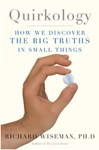
QuirkologyRichard Wiseman has just released a new book called Quirkology.

Grey Matter readers will remember him from his magic square performance video. Many others will remember him from his amazing color changing card trick video:


This video, as it happens, is an excellent example of what the book, and the Quirkology site, is all about. From the site:

'Quirkology' is a term coined by Prof Wiseman to refer to psychological research that is quirky. Much of this work uses mainstream methods to investigate unusual topics, or unusual methods to investigate mainstream topics.

The best way to get an idea of exactly what this means is to participate in some of the live experiments yourself (UK link), or even some of the past experiments (UK link)!

Any who knows me will tell you I am a big fan of all things quirky and whimsical. Beyond just being quirky for quirkiness' sake, however, Quirkology looks into these ideas analytically. The scientific search for the world's funniest joke is about much more than just which joke is truly the funniest one, but about what can be learned in the search. Check out the introduction (UK link) for a better idea of the book.

If you relate quirky ideas to magic tricks (as happens in the book), then I'd describe this not as learning how a magic trick works, but rather why the magic tricks work, and how they are perceived. For a student of human nature and ideas, Quirkology ranks right up there with Made To Stick.