0

Calculators: Past, Present and Future

Published on Thursday, May 03, 2007 in , , , ,

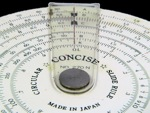
Circular Slide RuleWhile I've discussed methods of calculations numerous times, I haven't talked much about the means.

The oldest calculating device would probably be the abacus.

In the west, however, the most popular calculating device, for the early part of the 20th century, was the slide rule. If you're not familiar with them, Eric's Slide Rule Site features a wonderful introduction to them. Once you get used to the idea of logarithms, they're easier to understand. This YouTube explanation of slide rules may help you understand further.

Once you've read and understand about slide rules, you may want to try them out yourself. You can try out the UniVirtual Slide Rule (Java required) or even try out different slide rule models (Javascript required). If you prefer to run a slide rule application on your system, you can download Caveman's Calculator for Mac OS X or Slide Rule 1.1 for any system.

Once you get the basics down, you can even learn a few slide rule tricks to make your work easier.

The death knell for the slide rule, of course, was the modern electronic calculator. Most operating systems today even come with a virtual calculator. The modern calculator is worth exploring further. You may not even realize that the calculator with your operating system can be switched into other modes of which you may not be aware (See here and here).

You can download numerous other calculators, depending on your goals. For example, let's say you wanted to show off your ability to multiply two 9-digit numbers in your head. In this case, you would need a high-precision calculator, such as the Magic Number Machine for Mac users or the Precise Calculator for Windows users. The variety of specialized calculators is truly mind-boggling.

That covers the past and present of calculators, but what about the future? The most amazing version of a future calculator that I've seen is the one in this video:


You may be thinking that this free-form calculator is simply a pipe dream, but it is available as a free download (Java required) from Weapons of Math Construction.

That's enough for now. I've given you plenty of calculators to play with, so I'll let you go play.


0

Brain Fun 3

Published on Sunday, April 29, 2007 in , , , , ,

BrainHere's a quick trip around the internet for a great collection of various mental challenges:

* Cognitive Labs's Mind Games section features plenty of puzzles and just pure fun to strain and entertain your brain!

* The plus magazine puzzle page contains some amazing and unique challenges, such as this month's Clock Sudoku.

* Granted, Finger Frenzy 2 involves typing quickly, but the fact that you have to recall the alphabet backwards adds the mental part of the challenge. In case you're wondering what a good time for this challenge is, check out this video of the entire alphabet being typed backwards in 3.016 seconds!

1

Learning a New Language

Published on Thursday, April 26, 2007 in , , , ,

GlobeLiving in Las Vegas, it's not uncommon for me to run across people from all around the world. As this has been happening to me more and more, my thoughts are beginning to turn to learning a new language. In my case, learning a second language is becoming more and more economically important, which is just one of the reasons discussed in the article When do people learn languages?.

At first, the task seems daunting. However, my strong interest in memory techniques is a big help. Also, I've been looking at numerous approaches and software programs. Much of the free software I've been investigating has received better reviews than all but the most expensive language programs. Especially well suited to learning vocabulary are Ebbinghaus, which I've reviewed before, and ProVoc. I mention these programs especially, because both feature online libraries which offer both upload and download capabilities.

Once you have the software, and supporting vocabulary files ready, there is still the matter of learning the language quickly and effectively. Sure, the quizzing can do this, but what about remembering words in the first place? For memory techniques applied to language, first you should get familiar with the basics first. Next, learn how to specifically apply them to memory techniques, as in How to... Learn a Foreign Language (especially interesting is the Town Language Mnemonic). If you prefer a little more detail in how to learn a language quickly and effectively, read How I learned French in One Year. It's the story of a geek who had to learn enough French, in only 10 months, to pass a standardized Canadian test, and how he acheived it.

Now, my particular interest in learning another language was piqued by people who speak other languages visiting Las Vegas. However, if you're learning another language with the intent of visiting another country, then you'll want to learn both the language and the culture.

If you'll excuse me, I'm going to start working on my Spanish now.

0

The States

Published on Sunday, April 22, 2007 in , , , , ,

Continental United StatesLast night, The History Channel premiered a new series, titled The States. Instead of a 50-part series delving into the complete history of each American state, as you might expect, it's a 10-part series, with each episode focusing on 5 different states. You learn about the unique culture and interesting facts about each state.

I bring this up because memorizing the US states and capitals is a classic feat of memory. It's unusual enough that people find it hard to name all 50 states in a short time, and even harder to name the capitals. As a matter of fact, most of the people who can do both learned it from Wakko Warner.

Fortunately, there are plenty of tools online to help you learn (mostly Flash-based). You can practice placing the US states on the map, finding the states, and the state capitals, too!

Probably the best thing about the series The States is that once you learn your states and capitals, you can not just show off your knowledge, but make it interesting as well. Would you rather just hear the dry fact that Sacramento is the capital of California, or hear it balanced with neat facts like California's name means absolutely nothing, and was just a made-up name for a place in Spanish mythology?

0

6th Carnival of Mathematics

Published on Thursday, April 19, 2007 in , , ,

CarnivalThe 6th Carnival of Mathematics is up over at Modulo Errors, and a day early, too!

Grey Matters readers should enjoy this edition, as there are plenty of mathematical recreations and puzzles for those of all levels.

The next Carnival of Mathematics is scheduled for May 4th at Nonoscience.

0

Werner Miller's Age Cube

Published on Thursday, April 19, 2007 in , , ,

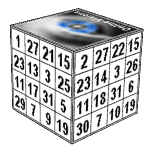
Age CubeSince all the posts since last Sunday have focused on history, it's only proper to wind up “history week” by showing you something new created from something old.

Regular readers will remember my previous mention of Werner Miller, a retired mathematics teacher from Germany who regularly contributes to Online Visions, and is the author of Ear-Marked, a great book of mathematical magic.

Yes, it's Werner Miller who has taken two old ideas and turned them into something new. He's combined the classic age cards and the classic magic square into his new creation, the Age Cube!

It's apparently just a promotional cube featuring your information on one side, and different magic squares on each of the five remaining sides. However, it also allows you to perform the classic age card trick. The fact that they're arranged in the form of magic squares helps hide the binary basis of the effect.

Since this trick isn't a particularly deep mystery, it can also be taught with the give-away, for added value. This will most likely be kept much longer than a simple business card.

This isn't to say that the age cards, originally published in 1801 in Recreations in Mathematics by Charles Hutton, can't be improved. In a post from last June, the principle is applied to phone numbers. Owners of Stewart James In Print should look up Mentalscope, in which the principle is applied to letters.

2

Connections and The Day The Universe Changed

Published on Tuesday, April 17, 2007 in , , ,

James BurkeMy last post of 2006 concerned the TV show Connections being uploaded to YouTube. Perhaps not surprisingly, YouTube has since removed this series.

Thanks to Clickcaster's Connections video podcast, you now have a second chance to see the complete series! Since this is a podcast, you can subscribe to it and store it on your computer or portable MP4 player to watch at your convenience. Also, each episode is a single file, instead of the chopped-up episodes posted on YouTube.

As an added bonus, Clickcaster also has every episode of The Day The Universe Changed, too! This was James Burke's second documentary series, released in 1985. While Connections focused on several central inventions, such as the atomic bomb, the telephone, the computer and so on, The Day The Universe Changed focused on the historical moments that whole concepts changed, such as medicine, physics, and finance.

Instead of the traditional linear manner of teaching history, where it's taught that first came the telegraph, then the telephone, then the TV, both of these series teach history in a ping-pong manner. Did you know that, when the Normans first used the stirrup in the Battle of Hastings, it started a chain reaction that lead to modern telecommunications? Does it even seem possible that El Cid and his band made an accidental discovery that led directly to the invention of the modern university degree? Just like today doesn't happen in straight lines, neither did the past. James Burke's unique manner of teaching history helps give it a more real-world feel, and makes it easier to grasp.

If you're not familiar with either of these series, I ask that you at least consider taking a look at the first episode of both. The podcasts are free, and the time invested in learning about history in such a highly involving manner will be time well spent!

0

500-year-old Math and Magic Book

Published on Sunday, April 15, 2007 in , , , , ,

Luca PacioliThe newest book of magic and math puzzles out there is also one of the oldest. On Tuesday, the Guardian Unlimited announced the first formal translation of Luca Pacioli's De viribus quantitatis, a 500-year-old book of math puzzle and magic tricks, into English. As the story notes, Luca Pacioli shared lodgings with Leonardo Da Vinci, and was believed to help Da Vinci with The Last Supper.

Reading the full story, you start feeling amazed at the discovery of this impressive work. As much as I love amazement, it isn't truly warranted in this case. De viribus quantitatis hasn't been missing up until recently, as Martin Kemp points out. Re-read the Guardian story again, and you'll note that the lead contains the true story, that of the first formal translation to English.

As a matter of fact, the University of Bologna itself has had excerpts from De viribus quantitatis available online for sometime now. If you don't happen to speak Italian, you can get Google to translate these excerpts for you.

Even if this isn't a major academic discovery of a long lost work, the English release of this work should still be a source of anticipation. Seeing the perspective that great 15th and 16th century thinkers bring to magic and math puzzles could definitely be worth the wait.